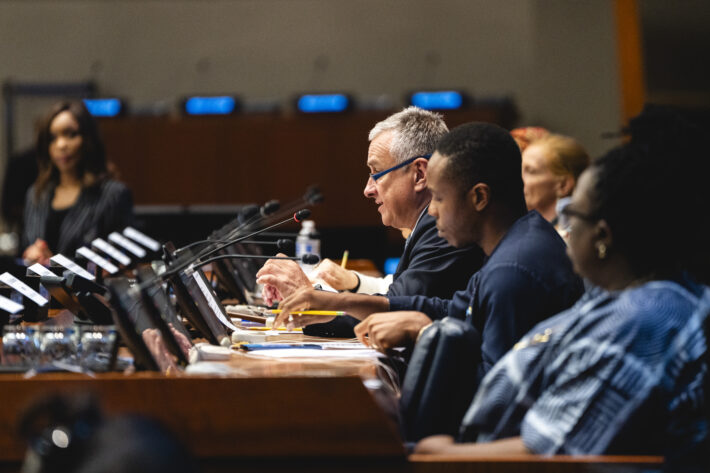
A panel of advocates, officials and policy makers gathered for the U.N. General Assembly last week to discuss gender-based violence.
The event, “Full Speed Ahead: a Global Partnership to Eliminate Violence Against Women and Girls,” was hosted by The Spotlight Initiative, a United Nations program that centralizes efforts across several U.N. agencies to advocate for women’s rights.
Coinciding with the 80th anniversary of the United Nations, the forum, held at the U.N. headquarters, featured over a dozen speakers who discussed the importance of the Spotlight Initiative, which launched in 2017. Before this year, Spotlight focused on small pilot projects to increase legal protections for women, such as developing programming for civil society organizations, and distributing U.N. funding to those organizations. Now, Spotlight 2.0 plans on increasing its programming at the regional level to help refugees and women with disabilities.
“Over the next five years, an estimated 4.2 million people are expected to benefit directly from Spotlight 2.0,” said Gbeme Horace-Kollie, Liberia’s minister of gender, children and social protection. The next phase will also expand geographically to new districts in Uganda, Zambia, and Sierra Leone, adapting programs to fit their specific cultural needs and advocating for gender-based violence legislation in crisis zones, said Horace-Kollie.
The speakers also discussed how these initiatives rely on significant contributions. Initial funding in 2017 came from a 500-million-euro donation from the European Union along with gifts from private donors. Now, the EU plans to commit $20 million more for the expansion into Uganda, according to Amma Twum-Amoah, African Union commissioner for health, humanitarian affairs and social development.
“Investment in women and girls’ is transformative,” said Twum-Amoah. “Closing gender gaps in education, health, and employment could add billions annually to Africa’s GDP.”
But women weren’t the only focus of the discussion. Several speakers mentioned the importance of educating men and boys about gender-based violence and involving them in policy making.
“Defending women’s rights should certainly not be reserved for women alone,” said Maxime Prévot, Belgium’s deputy prime minister and minister of foreign affairs. “It’s a “universal struggle.”
Mexican actress and advocate Cecilia Suárez agreed. “We need men to join this fight,” she said. “We need to implement education that talks to men directly.”
While many Spotlight 2.0 initiatives focus on gender-based violence prevention on the African continent, it’s an issue in New York City too. According to NYPD crime data, this year there have been 1,475 reported rapes from January 1 to September 21, a 20.2% increase compared to the same period last year.
After the event, one of the panelists, Amanda Nguyen, astronaut and social justice advocate, spoke to a line of girls waiting to meet her. Her nonprofit, Rise, advocates for survivors of sexual assault through policymaking.
“New York, for us, was such a battleground at Rise,” Nguyen said, referring to the organization’s efforts to pass the Sexual Assault Victim Bill of Rights in 2018. The legislation guarantees the right to forensic exams and rape kits. “We have members on our team who are survivors from New York and we are so proud that the Sexual Assault Victim Bill of Rights passed in New York,” she said.
“It’s not just a women’s issue, as we’ve heard, but it’s a human issue and it concerns all of us,” said Kirsty Coventry, International Olympic Committee President, during the panel. “No single organization can solve this alone. Partnership is key and the Spotlight Initiative shows what we can achieve when we work together.”