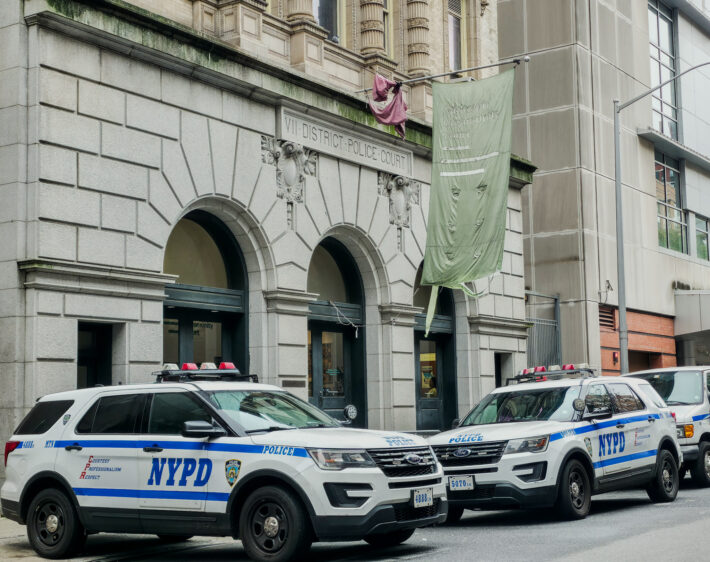
In an unassuming building in Hell’s Kitchen is a court that’s reimagined what justice can look like.
More than 30 years ago, New York’s court system partnered with the Center for Justice Innovation, an advocacy organization of justice and social services professionals, to create the nation’s first community court.
Officially called the Midtown Community Justice Center, the court offers alternatives to incarceration for misdemeanors. Rather than sending people to jail, the center connects them with resources designed to help at-risk adults build stability and move away from cycles of crime.
Now the building itself is being redesigned to better reflect the center’s mission. Although the plans haven’t been finalized, former jail cells that once housed defendants will be turned into a community center. The space is being planned to offer areas for social worker–led sessions, a comfortable waiting area, and a place where parents attending court can bring their children.
“There is this narrative of turning harmful spaces into healing spaces,” said Danielle Mindess, the center’s project director. “Places where people were once jailed into spaces where people can heal.”
The cells will still function as backup holding areas for the city, which means the design must allow the space to serve both purposes. Michael Baldwin, the supervising Legal Aid attorney at the center, said he hopes the dual-purpose design will be handled thoughtfully, but he has some reservations.
“Talk about the trauma of your arrest in a cell, you know?” Baldwin said. “Just seems to me to be a little odd.”
But the idea of the design is connected to years of research.
One of the main reasons the center is transforming its jail cells is to put restorative justice into practice, an approach that criminologist Howard Zehr pioneered in the 1970s. The idea is that when harm occurs, the people and community affected should have a say in how justice is carried out. Zehr credits Indigenous traditions of peacemaking for inspiring this model. The center itself has sought guidance from Native American practitioners to teach staff about restorative justice practices.
The court oversees several specialized programs for people charged with low-level offenses in Manhattan. One of them is the Manhattan Misdemeanor Mental Health Court, where a lawyer, judge, prosecutor, or defense attorney decides a person’s behavior may be linked to a mental health condition. Those individuals receive personalized support and treatment while their case is resolved.
The center also handles nearly all misdemeanor desk appearance tickets, where a person who was arrested receives a ticket instructing them to return to court on a specific date, instead of being detained in jail. On Thursdays, the court focuses on people age 18 to 25, offering programs tailored to young adults whose decision-making skills are still developing.
“Downtown, if you’re arrested, you go through the system and they make you plead guilty to some low-level crime or even something like disorderly conduct, and they hang jail over your head,” said Baldwin, explaining how the Midtown Community Justice Center differs. “The idea here is to not threaten people with jail. It kind of makes it so that they’re empowered to do the work, right? They don’t feel like it’s forced upon them.”
Through the years, the center’s alternatives to incarceration have become a preferred and successful response to crime. According to a 2024 report by the Center for Justice Innovation, more than 10,000 participants in its New York City court-based programs had their charges reduced or dismissed after successfully completing mandated programming. The center has also supported over 400 organizations nationwide in developing community-based justice initiatives.
These mandated programs are what participants go through instead of traditional prosecution. A defendant’s case first goes through the District Attorney’s office, which helps determine what kind of program might be appropriate. After that, the center’s staff meets with the participant to assess their needs: looking at their personal situation, challenges, and support networks.
Based on that assessment, social workers design an individualized plan that can include harm reduction sessions, help applying for public benefits, or group workshops such as stress management or financial literacy. Each plan is meant to address the root causes of the offense and help participants build stability in their daily lives.
“The work has just become increasingly more person-centered, and so it’s less of a cookie-cutter model where someone comes in and they’re given X, Y, or Z responses,” said Jordan Otis, the center’s deputy project director. “Folks across the table are really looking at the individual and trying to best understand what their needs are and how we can support them.”
The cell renovation project is expected to take about a year. When the space finally opens, Mindess hopes it will send a clear message to the community “to show folks who have maybe made a mistake or engaged in harmful behavior that we see them as human,” she said, adding that the center wants to “invite them back in rather than close the door and shut them out.”