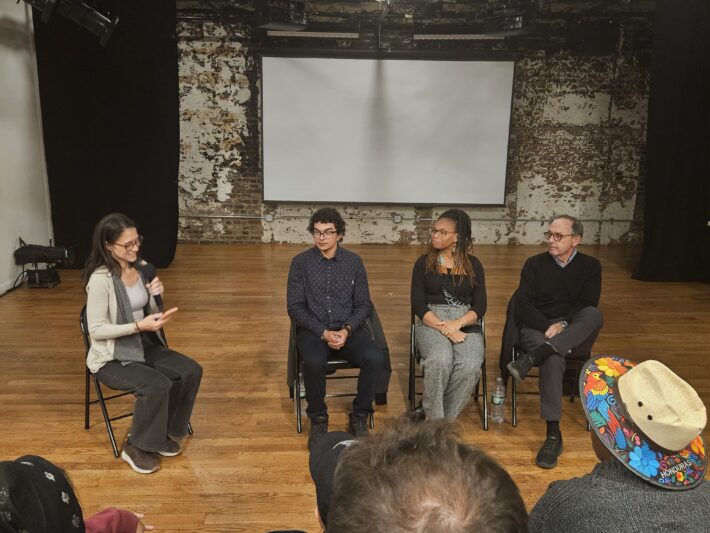
Activists fighting to stop the demolition of public housing in Chelsea drew New Yorkers from across the city to a screening and panel on Oct. 6 at Jack, a community arts space in Clinton Hill, Brooklyn.
The New York City Housing Authority, NYCHA, plans to demolish existing buildings at Fulton and Elliott-Chelsea Houses in Manhattan and replace them with new units, in partnership with private developers Essence Development and Related Companies. The plan affects 2,056 households. Housing experts and activists on the panel said that stopping the plans will take more than organizing by residents themselves. It will take New Yorkers from every neighborhood.
The event, a screening of “A Home Worth Fighting For: The Push to Stop the Demolition of Public Housing in Chelsea,” drew a multigenerational crowd eager to learn what is happening in Chelsea and how to get involved. Around 35 people filled every seat, asked questions during the panel, and cheered and applauded the panelists’ answers.
“I wanted to support the film and learn more about what’s going on,” said Janice Taveras, a 26-year-old Bronx resident who grew up in NYCHA housing, where her mother still lives. “I also wanted to learn about the strategies they’ve been using to push back.”
The documentary, directed by Natasha Florentino, follows longtime residents of the Fulton Elliott-Chelsea Houses who are trying to prevent the demolition of their homes. The film alleges that NYCHA misled residents during the planning and approval process, including by handing out a survey that did not use the word “demolition” and was later cited as a sign of resident support for the project. The documentary also points to a lack of transparency behind a drastic increase in cost assessments. In 2021, NYCHA estimated $366 million dollars to repair units across all Chelsea developments. The estimate rose to $927 million dollars in 2023 and was based on a study conducted by the developers, a clear conflict of interest. Tenants’ demands to see the full study have not been met, according to the film.
“I feel like so much information about this issue is distorted by the media,” said Florentino, in an interview after the panel. “I felt like my role was to fill in the blanks and give people the information that they are not getting and deliver it factually and clearly.”
The panel ended with ways to get involved, presented by Caitlin Cahill, a professor at Pratt Institute and a member of the Chelsea Public Housing Coalition, a group of advocates formed specifically in response to the demolition plans. Attendees received leaflets outlining the campaign, along with a separate primer on the health risks of continuous construction, which NYCHA estimates to last 15 years. The illustrated flier says that the plan would cut down 370 mature trees, worsening heat waves, and that the dust and toxins released into the air could lead to respiratory problems.
“We think the safest thing we can do is stop the demolition,” said Cahill. “But if parts of it go further, we are going to keep trying to stop every single part.”
Arlene Keizer, 62, a Clinton Hill resident who did not know what was happening in Chelsea before the event, said the panel changed how she sees the issue.
“It reinforced my sense that low and middle-income New Yorkers are in a battle for our very survival,” she said. “I plan to sign the petition to Mayor Mamdani to prevent the demolition and I may join the protests over this issue in the future.”
NYCHA, meanwhile, is moving forward. At the end of 2025, the agency began issuing relocation notices to 103 households in two buildings, Fulton 11 and Chelsea Addition, which is for seniors only. About 20 senior households from both buildings have refused to relocate, having never supported plans and and seeing relocations as too taxing on their aging health.
Whether the relocations have been truly voluntary is disputed. Tenant advocates said the notices threatened legal action for failure to relocate within a certain time period, and that in itself is coercive. NYCHA followed through with lawsuits in December 2025, requesting an order to make the seniors move and provide monetary compensation for the delays. The judge refused this order, and NYCHA withdrew the lawsuits. This past July, several tenants who say they were harassed into leaving filed tenant harassment claims against NYCHA, supported by a legal fund raised by the Chelsea Public Housing Coalition.
NYCHA said that it continues to work with residents who haven’t relocated, and that each household had been offered refreshed temporary apartments within the same development that meet their needs, said Andrew Sklar, NCYHA deputy press secretary, in a written statement. He added that more than 70 households “have completed their moves and are awaiting construction of their new homes.” Sklar also said, “We remained committed to ensuring this redevelopment project at Fulton and Elliott-Chelsea is delivered as promised.”
The coalition plans to organize at the upcoming NYCHA board meeting happening on Oct. 20. It is encouraging as many people, even non-residents, to speak in-person against the demolition plans.