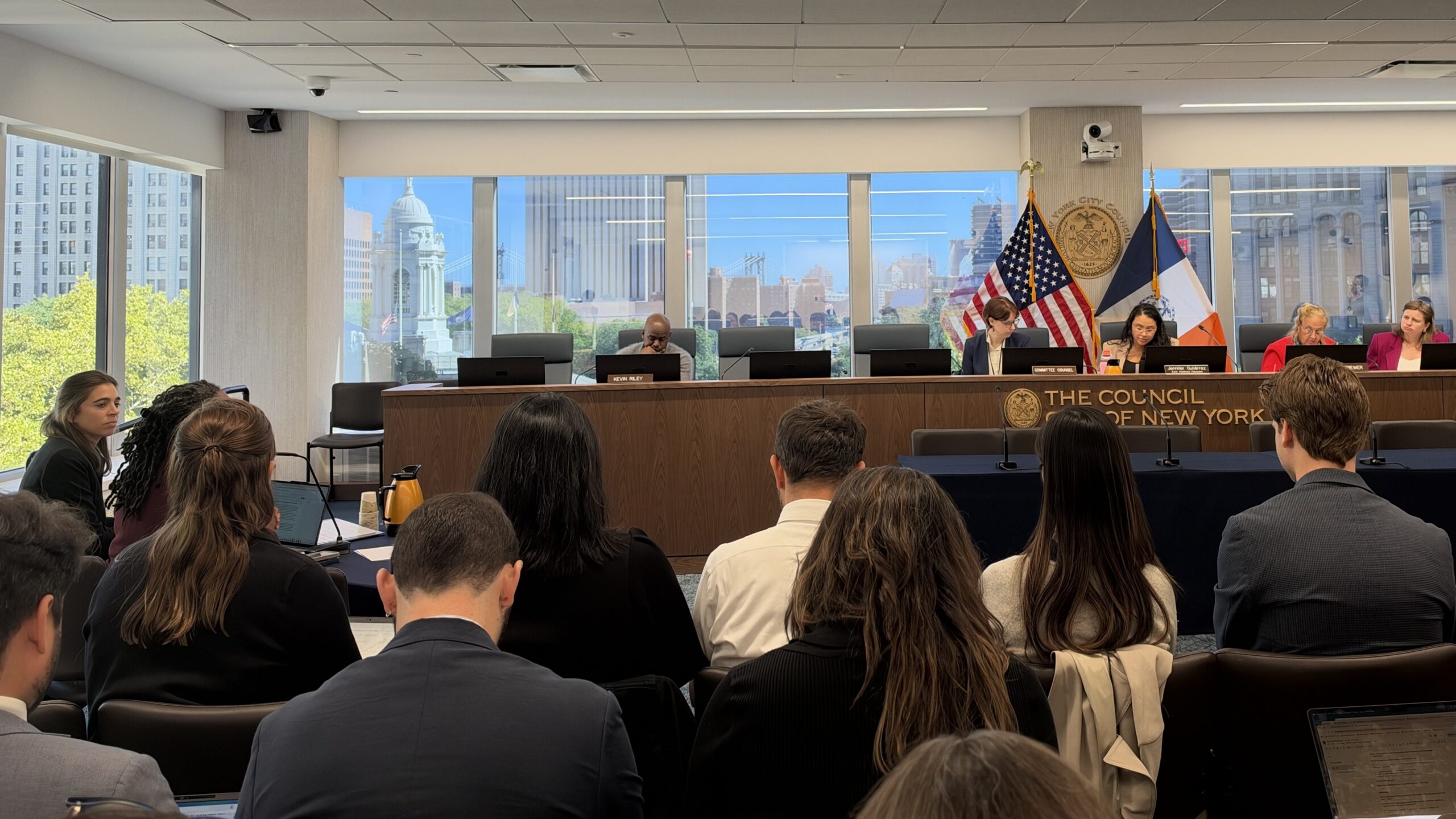
As New York City races to deliver on Mayor Zohran Mamdani’s signature promise of free child care for every 2-year-old by fall 2029, advocates and city council members urged the city at an Oct.7 hearing to fix chronic payment problems in childcare before expanding 2-K.
The 2-K program will receive $425 million in state funding next year to grow sixfold and serve 12,000 children, according to the mayor’s office. But speakers at the hearing, which about 40 people attended at the council’s offices at 250 Broadway, said delayed payments to providers and pay inequities among early childhood educators could drive teachers out of the field. That would leave 2-year-olds without the continuity of care they rely on to feel secure and to learn.
“We need to make sure that we are building a sustainable childcare system, not simply adding seats,” said Robert Cordero, CEO of Grand Street Settlement, a community-based nonprofit.
Unlike pre-K and 3-K programs, which are offered in public schools, community-based organizations and family childcare homes, 2-K is provided only through community-based organizations and home-based providers. Those organizations struggle to compete on pay. A 2024 audit by the New York City comptroller found that 90% of experienced lead teachers with master’s degrees at community-based organizations earned less than public school teachers with similar experience. Among those with eight or more years of experience, the median gap was $19,952.
“We don’t have enough teachers now,” Cordero said in an interview after the hearing.
The distance between current staffing and what the city would need is wide. New York City health rules require at least one staff member for every six 2-year-olds in a childcare center, and the city has about 32,900 childcare educators and directors, according to a report from the Subcommittee on Early Childhood Education. The city’s Child Care Advisory Board estimates that a universal childcare system would need about 70,000. Retention adds to the challenge: Nationally, between 26% and 40% of early childhood educators leave their jobs every year, according to a 2021 U.S. Treasury report.
That turnover matters for 2-year-olds, who learn through play, exploration, and positive interactions, according to the city’s public schools website. Research from Harvard University’s Center on the Developing Child shows that stable relationships with caregivers are essential for healthy development, helping very young children feel safe and build social and emotional skills.
At the hearing and in an interview afterward, Cordero recommended that the city build its early childhood workforce and attract more people to the field, including by offering tuition-free education to students aspiring to be preschool teachers and creating career pathways.
“You have to pay good wages to make sure that people stay in those jobs more than one year,” he said afterward.
Council Member Jennifer Gutiérrez, who chairs the Subcommittee on Early Childhood Education, said providers have raised pay inequities at every hearing the subcommittee has held.
“Early childhood educators are the heart of the early childhood education systems and deserve to receive dignified wages,” she said at the hearing.
City officials acknowledged the problem. “Wage equity is something we must address in the early childhood sector,” said Emmy Liss, the executive director of the Mayor’s Office of Child Care and Early Childhood Education, who testified for the administration. She added that the inequities have existed for decades. A spokesperson for the office said in an email that the city recently announced nearly $700,000 in new investments to train 46 early childhood educators through apprenticeships, intended to improve how the city recruits, trains, and retains them. The announcement did not include raises for teachers already working in the field.
Gutiérrez said in an interview after the hearing that the city still needs to do more to serve multilingual families and children with special needs as it expands, but she expects the 2-K program to keep growing so more 2-year-olds have access.
“A program like this is very hard to walk back,” she said.