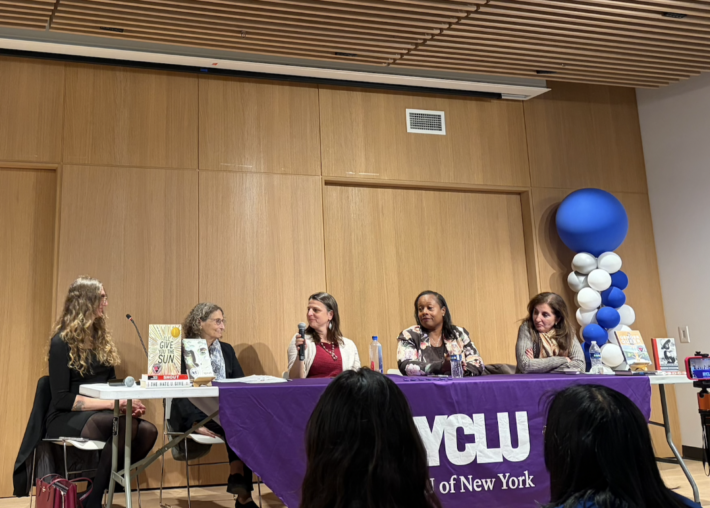
Many New Yorkers think book bans happen somewhere else. On Oct. 8 at the Brooklyn Public Library’s Brooklyn Heights branch, a panel of local librarians, authors, and civil-liberties advocates gathered to argue otherwise.
The Brooklyn Public Library, independent bookseller Books Are Magic, and the New York Civil Liberties Union (NYCLU) co-hosted the event as part of Banned Books Week, a campaign launched in 1982 to spotlight censorship efforts in libraries and schools. The panel came amid a nationwide surge in book challenges that advocates say has reached deeper into New York than many residents realize.
“People think it can’t happen here,” said Donna Lieberman, executive director of the NYCLU. “But from Long Island to Buffalo, it can.”
A Right to Read Coalition report found that 45% of New York educators surveyed said they or a colleague had received parent complaints about classroom books since 2020. Forty-nine percent of school librarians and 55% of public librarians reported similar experiences. Nationally, the American Library Association (ALA) tracked 4,235 titles challenged in 2025, more than 15 times its annual average of 273 between 2001 and 2020. The ALA says 92% of book challenges came from pressure groups, government officials, or decision makers, up from 72% the year before.
Karissa O’Reilly, a school librarian in Putnam County, is facing these challenges herself. In 2022, parents at Carmel High School challenged “Gender Queer,” a graphic memoir by Maia Kobabe. The school board voted 5-2 to keep the book in the library, but O’Reilly faced public backlash. A parent with an online following posted her photo and contact information; messages poured in. “They called me names, said that I should step down, that I had no business working in a school,” O’Reilly said at the panel.
In July, “Gender Queer” was challenged again, and O’Reilly worries this time will be different. Bans have increased since then, and several newly elected members of the Carmel Central School District Board of Education campaigned on pulling the book, according to board member Michael Torpey.
All four panelists said the books under attack deal with “real life and its complexities,” as moderator Philomena Polefrone, PEN America’s Freedom to Read senior manager, put it.
Sonja Cherry-Paul, author and educator, focused on the disproportionate impact that book bans have on authors of color. According to a 2024 University of Pennsylvania study Cherry-Paul cited, authors of color make up 10% of U.S. authors but account for 39% of banned titles. “We have to be willing to ask why, along with who and what benefits from book bans,” said Cherry-Paul.
Cherry-Paul rejected the argument that certain themes are too mature for children. Schools already teach fire drills, active-shooter procedures, and stranger awareness because some children face those situations, she said. “But then we get to racism, and we suddenly stop. If some children are old enough to experience it, why aren’t all children old enough to know about it?”
Rhonda Roumani, a Syrian-American children’s book author who writes about Arab and Muslim children, raised the issue of author bans, or what she calls “soft bans.” She argued the term undersells the damage, saying that they are “more insidious because you don’t even see them.” Schools have interrupted or canceled author visits, including her own, over book content or unrelated personal social media posts.
All panelists shared the hope that attendees leave motivated to act and support policies that protect intellectual freedom. The NYCLU is working to pass the Freedom to Read Act, which the State Legislature reintroduced after Gov. Kathy Hochul vetoed an earlier bill in 2025, citing unclear wording. The legislation would require schools to implement policies ensuring that school staff are “empowered to curate and develop collections that provide students with access to the widest array of developmentally appropriate materials.”
Lieberman left audiences with a call to action: “No form of protest is too easy. Nothing is too mild. Get out and act.”