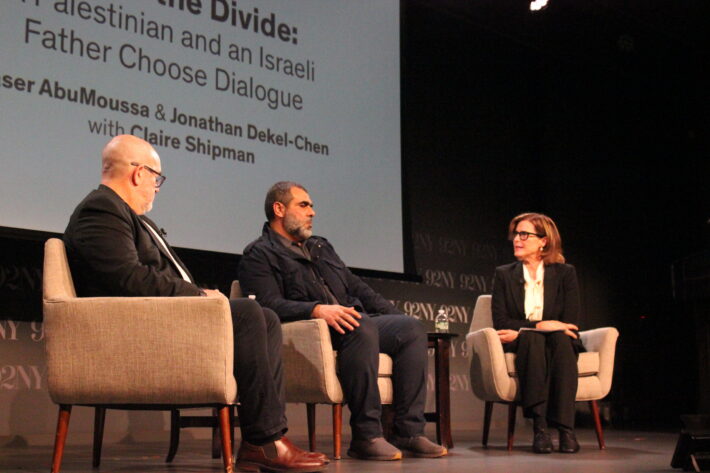
Two fathers—one Palestinian, one Israeli—met at the 92nd Street Y on Wednesday, Oct. 7, to discuss how to keep the suffering their families had endured over the past three years from becoming another generation’s inheritance.
Jaser AbuMousa lost his wife and two children to an Israeli airstrike in Gaza; his mother was killed in a later strike. Jonathan Dekel-Chen’s son, Sagui, was taken hostage by Hamas on Oct. 7, 2023, and released after 498 days. Three years into a war that has hardened feelings of distrust on both sides, their first conversation in front of an audience was a bet that those with the most reason to hate are best positioned to stop it.
“The answer,” Dekel-Chen said, “has to come from people like us, who have seen hell.” AbuMousa added, “It’s my choice to give the children the anger and the pain, or to give them a chance. And I will choose this chance every day.”
At the end of one of AbuMousa’s stories, he made a small joke about confusing centimeters and inches in front of the mostly American audience. The crowd took a beat before joining in the laughter, easing an emotionally charged conversation.
AbuMousa described his deep belief that “there is a hope to live together” even after the horrors of war. Dekel-Chen said that the only other path leads to a “trap of perpetuating hatred” that consumes people, families, and generations. “Is this what we really want as individuals and as citizens of the world? Is this what we really want for Jaser’s and my children and grandchildren?” he asked.
As the evening came to a close, moderator Claire Shipman, Columbia University’s former acting president, asked both men to share their thoughts on the potential for a broader political reconciliation between Palestine and Israel. “Let’s not talk about big ideas. Let’s talk about things that can be done right now, which is to allow the people of Gaza to live,” AbuMousa urged. Dekel-Chen said that an opposition victory in the upcoming Israeli elections was a necessary step toward any political solution.
International human rights organizations, including Doctors Without Borders and Human Rights Watch, have described Israel’s campaign in Gaza as a genocide.
After the conversation ended, AbuMousa huddled outside the venue with a small crowd; attendees stopped to shake his hand, and one man pulled him into a tight embrace. “I think it went well, from the reaction,” he said. “I did not expect this.”
Among those in the hall was Gillie Halfone, a Rutgers student who grew up in Israel. She has friends of friends who were killed on Oct. 7 while serving in the Israel Defense Forces. After the attacks, she became “deeply invested in the movement to bring the hostages home” and frequently protested against Israel’s military actions in Gaza. She said conversations like the one AbuMousa and Dekel-Chen had were “truly the only way to bring about change and to see the humanity in one another.”
Danae Husary, a young Palestinian-American woman whose father is from the West Bank, stood nearby with her boyfriend, Alex, a Jewish man who declined to share his last name. “I’ve already got enough hate for my beliefs on social media,” he explained. For the couple, the conversation on stage mirrored ones they’d had together, though intensified by the loss both fathers have experienced.
Husary found it refreshing that the two men on stage could speak frankly about that loss without turning the conversation into a debate over who had suffered more. “I think that the issue for so long was everyone’s trying to compete [about] who should be more sad for the other… I think that was always hard,” she said. “It was really nice to see two people from diametrically opposite sides of the spectrum sit there and have a conversation and be willing to lead by example,” added Alex.
Speaking two days after their conversation, Dekel-Chen said that he hopes “audiences of all kinds can come away sort of questioning their own dogmas, whatever those might be, by virtue of having seen, heard, read what we’re saying.” In the end, said AbuMousa, the exchange will only be a success “if something really moved afterwards; if we have more than Jonathan and Jaser talking to each other.” If that happens, even after all he, Dekel-Chen, and so many others have suffered, “I think everything is possible.”