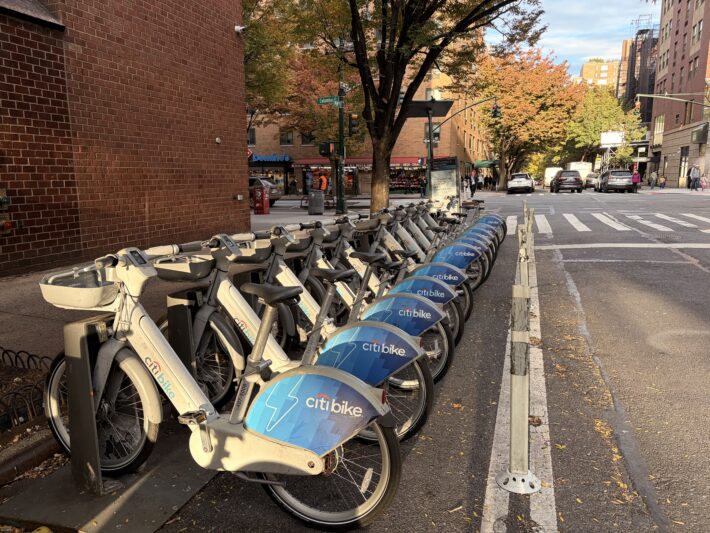
Some evenings, Katie McQuerry gives up looking for a station to dock her bike. After circling her neighborhood on her Citi Bike and finding every nearby station full, the film editor has ridden farther to find a dock, and on some days has left her bike at a distant station and taken a cab the rest of the way home.
She isn’t the only one running into full stations. At 6 p.m. on two consecutive evenings in October, the Citi Bike station at Park Avenue and East 40th Street had no available docks for riders returning their bikes, according to an analysis of the system’s live station data.
For Citi Bike commuters, full stations can mean circling blocks in search of somewhere to return a bike. The New York City Department of Transportation and Lyft, which operates Citi Bike, plan to add hundreds of new docks across the city this fall. But transportation advocates and a former city transportation official say new docks alone won’t solve the problem. Keeping docks open, they say, also depends on moving bikes from full stations to empty ones and on whether the city holds Lyft to its contract.
The problem isn’t limited to evenings. During a morning commute, McQuerry recalled struggling to find somewhere to dock. “I drove around for 10 minutes at 10 a.m. with lots of other riders looking for spots,” she said.
P.J. Davis is an insurance broker and also commutes by Citi Bike. “There’s definitely been times where I’ve screenshotted my app because I couldn’t find a single open dock at any of the stations within a 15 minute walk of my workplace,” he said, adding that it leaves him anxious about being late to work in the Bryant Park area.
The data confirms the riders’ experiences. An analysis of Citi Bike’s public live station data found limited availability at several Midtown stations between Oct. 12 and 24, particularly during morning and evening rush hours. The 72-dock station at Park Avenue and East 40th Street had no available spaces at 6 p.m. on Oct. 15 and 16. The station at West 42nd Street and Eighth Avenue also had no open docks during evening checks on three consecutive weekdays, Oct. 21, 22 and 23.
Other Midtown stations also reached capacity. Between Oct. 16 and 24, the station at 12th Avenue and West 40th Street had no available docks in 11 of 57 checks, including consecutive evening observations by the Midtown Gazette on Oct. 19 and 20. East 47th Street and Park Avenue had no available docks in nine checks, mostly during the morning and afternoon, while West 52nd Street and Sixth Avenue had none in five checks. The data does not show how long a station remained full.
The city’s answer so far is adding more docks. The Department of Transportation and Lyft plan to add hundreds of docks by this fall in high-demand areas including Midtown, Chelsea, Williamsburg, Greenpoint and Gowanus. Many will be added at “infill” stations, new stations in neighborhoods Citi Bike already serves. The plans are part of a broader Citi Bike expansion announced in December 2024 that brought Citi Bike into seven additional neighborhoods in the Bronx, Brooklyn and Queens.
Charlie Baker, a representative of Transportation Alternatives, a transit advocacy group, said expanding Citi Bike into more neighborhoods also requires increasing docking capacity in central Manhattan.
“As you expand outward, you also need to expand the density in the core of the system,” Baker said. “That means Lower Manhattan, that means Midtown.”
But available docks are only part of the problem. Stations fill up when many riders travel in the same direction at the same time, as commuters do each evening, while others run low on bikes. Lyft, as Citi Bike’s operator, sends workers to move bicycles from full stations to empty ones, a process known as rebalancing.
Jon Orcutt, who managed Citi Bike’s 2013 launch as the transit department’s director of policy, said commuting patterns make shortages difficult to eliminate.
“I don’t know if you can ever really fix the rebalancing problem because there are flows of people in one direction at certain times of day,” said Orcutt, who’s now the director of advocacy at Bike New York, a non-profit that promotes cycling and safer transportation policies.
Baker said Citi Bike’s growing fleet of e-bikes puts another demand on the same workers who must replace depleted batteries. That work can compete with efforts to distribute bikes between stations.
“If you send a van around to distribute batteries, then you didn’t send that van around to redistribute the bikes,” Baker said.
Citi Bike does have a partial fix. At scheduled times, valet attendants at high-demand locations, including East 47th Street and Park Avenue, accept bikes when stations are full. Orcutt suggested expanding that service to three or four busy Midtown stations, though he acknowledged the additional staffing costs.
“If you rode up and all 45 docks were full, the staff would just check the bike in,” Orcutt said.
Who pays for that service, and whether Lyft is already obligated to prevent full stations, comes down to the contract. The city’s contract with Lyft, which runs through 2029, sets performance requirements for station availability, with potential penalties when stations remain full or empty for extended periods. A 2023 city comptroller’s report identified roughly $812,000 in potential penalties for stations remaining full or empty too long and criticized the Department of Transportation for failing to impose those penalties. The Midtown data does not show whether October’s shortages violated those standards, because it does not capture how long stations stayed full.
“The question is whether DOT pulls the trigger on the sanctions that they can impose,” Orcutt said.
The Department of Transportation and Lyft did not respond to requests for comment.