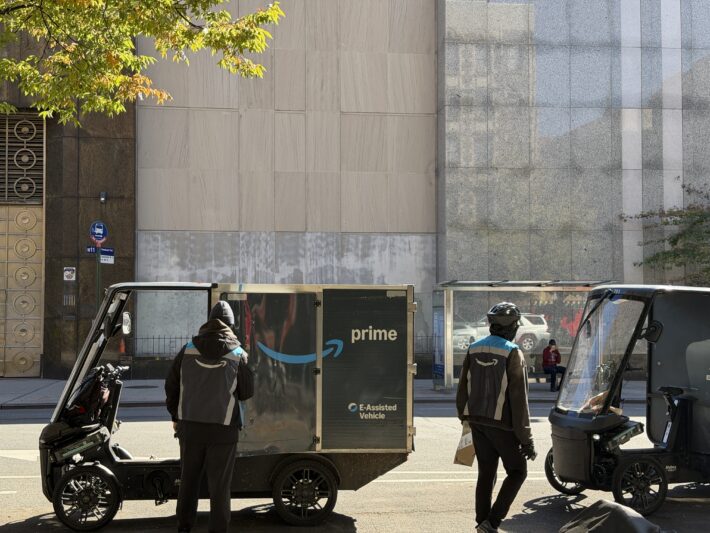
Most days, especially when it’s sunny, Tatyana’s job delivering Amazon packages on foot is straightforward. But when there’s rain, hail, or snow, it can quickly become challenging. Workers get just a 30-minute break, she said, and when the weather turns, many get sick but still come in because customers are waiting for their packages.
“They do give us ponchos, but that really doesn’t help. By the time I get home, my shoes are drenched,” she said.
Each morning, she meets an Amazon truck at a designated offloading point to wait for packages to be unloaded. She then uses a cart she pulls by hand to make her way around the city as a delivery walker.
Tatyana, who would not give her last name in fear of losing her job, wears an Amazon vest, but is employed by NYC Delivery LLC. It is one of more than 40 Delivery Service Partners (DSPs) in New York City, independent companies Amazon contracts to run its routes. A bill before the City Council would end that arrangement.
The Delivery Protection Act, reintroduced in February 2026 by Council Member Tiffany Cabán, would bar Amazon from using subcontracted delivery companies and require it to hire delivery workers directly. Supporters say the change would make the company answerable for driver safety and open the door to unionizing. Opponents, including business owners and the Manhattan Chamber of Commerce, say it would force small delivery companies to close. The fight is especially pointed in Midtown, home to Amazon’s primary distribution facility in Manhattan.
Amazon moves about 500,000 packages a day in the city, part of the 2.5 million that flow through city streets daily, up 39% from 1.8 million before the pandemic, according to the New York City Comptroller.
Few neighborhoods feel the volume like Midtown. Office towers and high-rise apartment buildings receive thousands of deliveries a day, and Amazon’s Manhattan distribution facility sits in the middle of it at 706 11th Avenue. Such facilities can generate up to 1,000 truck trips a day, the city comptroller said.
A comptroller report published in November 2025 linked rising collisions to last-mile delivery facilities, where goods are loaded onto smaller vehicles for final delivery. Average crashes near Amazon’s Midtown facility rose from 178 before it opened in 2021 to 195 after. Truck crashes near the 18 last-mile facilities across the city rose an average of 146%.
Safety standards are a key component of the bill. Among its most active backers is the Democratic Socialists of America, which counts Cabán among its members. Matt Maresca, a labor legislative coordinator for the group’s New York City chapter, said the subcontracting system lets Amazon avoid responsibility for the pollution and crashes its operation causes, because “their drivers are not getting adequate safety training.”
For Tatyana, the main problem is having no one to speak for workers. When there’s an issue, she said, employees go to management, “and if they don’t agree, they don’t agree.” She wants union representation.
For Maresca, too, a major issue is collective bargaining. He said workers who try to unionize under the current system risk Amazon canceling the contract with the employer. He pointed to Cornucopia Logistics, a Queens-based delivery company whose contract Amazon canceled in August 2025 after its drivers unionized. One-hundred and five delivery drivers were fired with no prior notice.
“NYC-DSA thinks that it’s critical that we figure out ways to enable the expansion of unionized workers throughout New York City and the country,” Maresca said, adding that the bill would make that organizing possible.
Direct hiring, he said, would shift accountability from “shell subcontractors that Amazon can always dispose of” back onto the company. In congested areas like Midtown, it would push Amazon to reconsider its delivery speed and aggressive route quotas, which put drivers at risk, he said.
But Delivery Service Partners owners reject Maresca’s shell company label.
Christine Chan, owner of Highgate Logistics, an Amazon contractor, said many of the companies are “Black and Hispanic-owned,” a point that the New York Hispanic Chamber of Commerce and Trucking Association of New York also emphasized in an April 9 city council hearing about the bill. “There’s the term subcontractor, but our employees are all W-2 employees with full health care, 401k, dental,” she said, adding that her company complies with all labor laws.
Chan said the bill would force her to move out of the city, leaving her workers jobless, and she doubts Amazon would hire them directly. “Our employees are very concentrated in low-income neighborhoods,” she said. “Like, what’s going to happen? All these people are going to be idle.”
The Manhattan Chamber of Commerce shares those worries. Jessica Walker, its president and CEO, said she agrees with the bill’s goal of improving worker protections and creating safer streets but rejects that it would solve those problems. It could push “Amazon or FedEx to just take warehouses and put them right outside of the city limits” she said, and “potentially close 100 small businesses in the city.”
Amazon agrees. The company declined to comment directly and instead pointed the Midtown Gazette to testimony it gave at the April 9 hearing. Amazon spokesperson Kelly Nantel testified that the Delivery Protection Act could put more than 5,000 delivery worker jobs at risk and force the company “to consider relocating delivery operations outside of the city.”
The Delivery Protection Act has strong support despite fierce opposition from business groups. It’s backed by 35 of the City Council’s 51 legislators, well above the 26-vote majority needed to pass. Mayor Zohran Mamdani endorsed it in August, turning a contested bill into a high-stakes political battle.
“When New Yorkers hear about the bill, they are ecstatic,” Maresca said. “I think that New Yorkers want to see politicians taking on big companies like Amazon.”
Whether the Delivery Protection Act becomes law will ultimately be decided by Speaker Julie Menin, who has yet to schedule a floor vote.