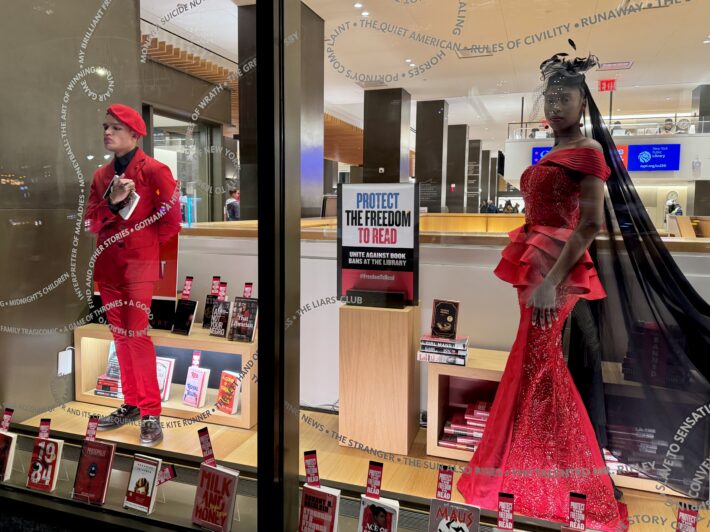
Nine models stood nearly motionless on tables and in the windows of the Stavros Niarchos Foundation Library on Fifth Avenue, on the evening of Oct. 7, each holding a copy of a banned book. Their eyes occasionally met the camera lenses and gazes of pedestrians on the sidewalk who stopped to stare.
The show, “Censored Chapters, Exposed Couture | A Banned Books Week Fashion Show,” was a collaboration between the New York Public Library and designer Glenroy March, and part of the library’s annual Banned Books Week programming. It came as the American Library Association reported a record 6,588 books censored, including 5,668 books banned from libraries in 2025. March’s designs were displayed alongside titles from a growing list.
March, a Jamaican-born, New York-based designer and founder of House D’Marsh, directed the models to stay still, like mannequins, from 6 to 8 p.m. “You are strong,” he told them. “You believe in what you believe in.”
Billy Parrott, director of the Stavros Niarchos Foundation Library, welcomed attendees, who then made their way through the library as NYPL programming staff handed out signs promoting the freedom to read.
“I thought it was a fire drill. I’ve never seen this before,” said Michael Samuels, who visits the library regularly.
NYPL programming staff met with March over three weeks to select pieces from his past collections and color-coordinate each look with a banned book. One model held a white-covered copy of Aldous Huxley’s “Brave New World,” and wore a structured white dress with a high-low skirt and fanned bodice. A halo of feathers was suspended on wires around her head. Another model, in a green hand-beaded dress, jutted her hips toward a white and green copy of Ralph Ellison’s “Invisible Man.” One woman, in a red peplum dress and black chiffon veil, stood beside a man in a red double-breasted suit and matching beret, March’s signature accessory. Together, they were surrounded by copies of Ray Bradbury’s “Fahrenheit 451,” Margaret Atwood’s “The Handmaid’s Tale,” and George Orwell’s “1984,” whose covers were red, white and black.
March said he took on the project because he recognized a connection between the freedom to read and the freedom of expression in fashion. He hoped that bringing the two together would draw people with different perspectives. “I focus on my art, and I want it to be for everyone,” he said.
Stephen Kostewicz, a student and model who goes by Papoy, discovered the show as he arrived at the library to study. “It’s nice to see when a designer has a message they’re trying to push,” he said.
The American Library Association launched Banned Books Week in 1982 after the Supreme Court ruled that school officials could not remove library books simply because they disagreed with their content. Since 2021, PEN America has documented 23,000 book bans in public schools across the country, a number the organization described as “never before seen in the life of any living American.”
Of unique titles challenged in 2025, 39% featured LGBTQ subject matter or people of color, according to the American Library Association. Less than 3% of challenges came from individual parents. But 92% were initiated by government decision-makers and pressure groups, including national nonprofits like Moms for Liberty, a conservative, parental rights organization.
Several attendees at the show were educators.
“Literature and literacy in general plays a central role in children being able to make sense of the world,” said Jacqueline Kolb, who teaches grades two through five at a Brooklyn charter school. “It’s a way for them to step into the lived experiences of other people.”
Ndeye Daro Niang, a high school teacher, said most of her students opposed the idea of authority figures telling them what they could read, but one student felt differently. “She was raised in a particular way of ‘listen to your elders,’” said Niang. She recalled telling the student, “I understand that you want to be respectful, but sometimes you need to disrespect things so you can learn.”
As the show ended, Zena George, assistant director of the Stavros Niarchos Foundation Library, encouraged attendees to get their library cards and introduced March, who thanked the NYPL team.
“It was a really easy collaboration,” March said. “I’m looking forward to many, many more.”
For Parrott, who has worked for NYPL since 2004, putting live models in the library’s windows had long been a dream.
“Fifteen years ago, 10 years ago, the idea of challenged books was not a thing in New York City,” he said. “Times have changed but the Constitution has not, and people still have the freedom to read and a choice to read what they want to.”