Jasmine Tay and her 14-year-old son had only four high schools to choose from within about an hour of their Upper East Side home. Her son uses a wheelchair and needs a fully accessible building. He was interested in only two of the four schools.
“He shouldn’t have to settle for a school just because it’s accessible,” Tay said. Now, he’s in ninth grade at a Midtown public high school, adjusting to a building that made the short list. The Midtown Gazette is not naming the school at the family’s request, to protect the son’s privacy.
His limited options reflect a citywide gap. New York City has more than 400 public high schools, but students who use wheelchairs face a much smaller pool of choices. Only about a third of city public schools were fully accessible as of April, according to the nonprofit Advocates for Children of New York.
In Midtown, between 14th and 59th streets, only nine of 44 public high schools were listed as fully accessible, according to a Midtown Gazette review of city data. Under the city’s definition, a fully accessible building allows a student with a mobility disability access to all its educational programs and services. Partially accessible buildings may accommodate a student’s needs, but some areas remain off limits.
“We have so much choice in New York City for all the different types of schools, and it is great that we have that choice,” Tay said. “But given he needs an accessible building, it significantly narrowed his choices.”
Even the schools that make the list don’t always deliver the independence students want.
At Frank McCourt High School on the Upper West Side, Tay found wide hallways and large classrooms that appeared easy to navigate. But she said an adult would have to operate the elevator with a key.
“Part of accessibility and inclusion is having independence,” Tay said. “It felt like a step back from where he was at middle school, and just sort of a bit of an insult to his independence.”
Staff there also told him he could skip gym. “But I like gym,” said the son, who does wheelchair racing and skiing.
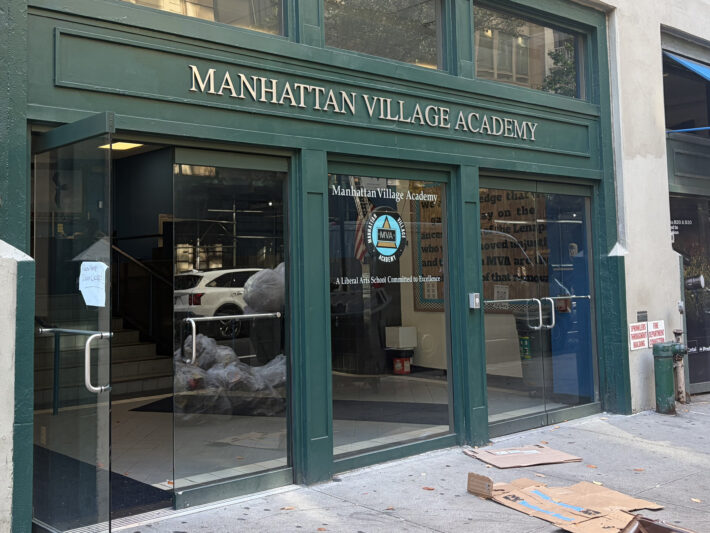
Other schools fall short of full accessibility altogether. According to the city’s assessment, the main entrance of Manhattan Village Academy in Midtown isn’t accessible because of its steps through the entrance. None of the classrooms, bathrooms, library, nurse’s office or science labs are on accessible routes, either.
Rinaldo Mazzella, 2025 graduate of Manhattan Village Academy, described how the building’s condition affected daily life. While he doesn’t have a disability, Mazzella said the school was hard to navigate for anyone who needed an elevator.
“Sometimes, its age showed,” said Mazzella, who recalled the elevators would frequently break down and take a while to repair. Students also needed a doctor’s note or an elevator pass to use them, he said.
Community Board 5 has asked the city to upgrade Manhattan Village Academy’s building, including improving access to educational facilities and adding at least one accessible restroom. New York City Public Schools said it could not accommodate the request at this time, according to the community board’s FY2027 budget request records. CB5’s district manager declined to comment. Manhattan Village Academy did not respond to requests for comment.
New York City Public Schools’ response fits a larger pattern: advocates say the city is making progress but not fast enough. Between 2020 and 2024, the city’s capital plan dedicated $750 million to school accessibility, including building ramps, installing elevators, and making renovations. The 2025–2029 plan includes $800 million to continue the work.
Chijindu Obiofuma, senior special education policy manager at Advocates for Children of New York, said those investments helped increase the share of fully accessible schools from fewer than one in five to about a third.
But about two-thirds of school buildings remain out of compliance with the Americans with Disabilities Act, she said. Obiofuma estimated that if funding stays at its current level in successive five-year plans, full accessibility could take 50 years. “That’s a lifetime for a lot of folks,” she said.
Advocates for Children of New York is asking the city to raise accessibility funding in the current capital plan from $800 million to $1.25 billion. Its proposal sets a goal of making at least 45% of buildings that serve as a school’s main location fully accessible by 2030. The group argues that the current allocation does not keep pace with inflation, despite being larger than the previous plan’s $750 million.
The city said it’s working on the problem. “Through our capital investments, we are continuing to expand building accessibility citywide, prioritizing districts that have not yet met established accessibility goals,” said Onika Richards, New York City Public Schools deputy press secretary, in an email. “While significant work remains, we are committed to making continued progress toward a more accessible school system that serves and remains accessible for all students and families.” Richards did not comment on Advocates for Children of New York’s budget proposal.
But the barriers aren’t only physical. Tay’s husband Brendan, who is identified by first name only to protect his son’s privacy, said a dance teacher in his son’s middle school didn’t adapt her instruction for him and gave him good grades even when he couldn’t fully take part. He said he would have accepted a lower grade if his son hadn’t engaged. What he wanted was a minute or two of separate instruction, a task or a move he could do, so he could be part of the class. “While my son was okay, I would want to make sure that other kids have access to great teachers with great approaches as well,” he said.
Brendan said he also hopes high school gives his son the tools he needs to succeed, “not just professionally, but also as a human being.”
For years, he said wheelchair users were often recognized mainly as athletes by going to the Paralympics.
“Yes, my son is great from an athletic standpoint,” he said. “But I would also love him to be great at communicating and interacting with people, regardless of whether they have a disability or not.”
“I think high school is really important for all of that,” he said.