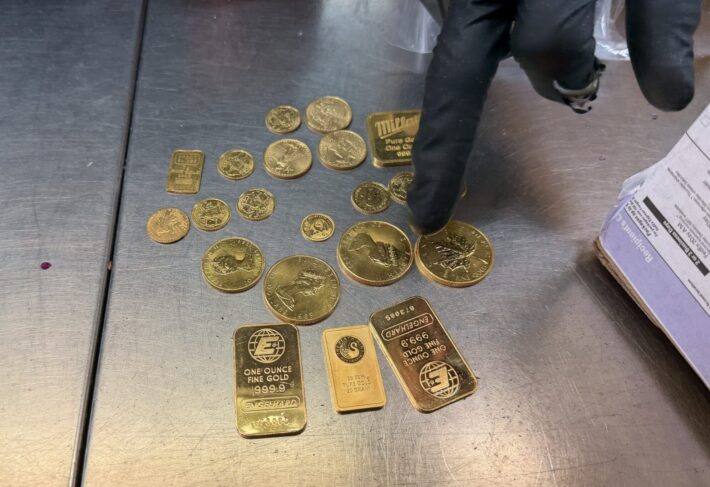
Five people waited at the counter of Bullion Exchanges on West 47th Street on a Tuesday afternoon, some there to buy gold, others to sell it.
A short walk up the block, Rafael Shimunov sat in the window booth of his shop, Simon Diamond, watching people pass. His cases were full of watches. No one came in.
“Profit’s very low,” he said.
A year of wild swings in the price of gold has divided West 47th Street. Large dealers with enough cash to buy in bulk and protect themselves against price drops have kept growing. Smaller shops, with less cash and fewer customers, say business has been thin. Jewelers whose pieces get most of their value from diamonds, meanwhile, have barely noticed. The Federal Reserve’s interest rate increase on Sept. 16, the first since 2023, did little to change any of that.
The block between Fifth and Sixth Avenues is the heart of Manhattan’s Diamond District, home to more than 2,600 businesses, according to the Diamond District Partnership, the area’s business improvement association. People come to sell old jewelry for cash or to buy coins and bars, and the small shops that buy their gold often resell it to larger dealers and refiners on the same street. Jewelers, gold buyers and watch dealers all depend on the same foot traffic.
Gold hit a record near $5,600 an ounce in late January, then fell more than $1,000 in four days, a drop of roughly 21%. On Sept. 22, it was $4,284 an ounce, according to a free price-tracking app run by Manhattan Gold & Silver, a precious-metals refiner on the block. That is still higher than gold had ever traded before last fall.
Jeffrey Christian, managing partner of CPM Group, a commodities research firm, Christian traced gold’s biggest moves to the Fed’s earlier signals, he said. When it hinted in August 2025 that rate cuts might be coming, investors around the world began buying gold. When it signaled in mid-March that cuts were unlikely, gold fell below $5,000.
Higher rates can hurt gold because it pays no interest: when rates rise, investors can earn more by moving money into bonds and savings accounts, which can weaken demand for gold and push its price down. But the September increase was only a quarter of a percentage point, and markets had seen it coming.
Christian said an extraordinary amount of gold was sold from January through July, as investors and people with jewelry cashed in.
“People were not buying gold jewelry,” Christian said. “It’s very expensive.” Anxious consumers wanted to hold on to their money rather than spend it on luxuries like jewelry, he said.
The swings have favored the biggest players. Eric Gozenput, co-founder of Bullion Exchanges, said the storefront accounts for only 2 to 3% of the company’s business. Most of its trading happens online, and the company has “just been growing,” he said, with volume on pace to rise 25 to 30% this year.
Smaller dealers, Gozenput said, lack the cash to keep gold on hand, so they sell what they buy to his company right away and keep a small cut.
Smaller shops tell a different story. At Simon Diamond, Shimunov said gold prices are “too high” but that isn’t his only issue. Customers also use ChatGPT to check watch values and arrive with a price in mind, he said, often focusing on the lowest estimate.
At Global Watches & Jewelry, owner Amin Sammy said that as gold climbed, roughly nine in 10 of his gold customers came in to sell. When prices eased, they kept selling. That meant paying out cash for gold, with few customers coming in to buy.
“I’m not gonna say good. It’s okay,” he said of business. “When the gold was cheaper, it was much better.”
The swings made it worse. When gold peaked, even the dealers who usually bought from Sammy “refused to buy,” expecting a crash. “And it did crash,” he said, referring to the late January plunge. An ounce of gold worth nearly $5,600 at the peak was worth about $4,400 four days later, a loss of more than $1,000 an ounce for any dealer stuck holding it.
Dealers across the market have been squeezed, Christian said. They are used to selling gold to investors, but as people rushed to cash in, they spent stretches of this year buying it instead. That tied up their cash and credit and cut into their profits.
Some businesses are insulated from the swings. At Zoland Jewelers, a family business founded in the late 1920s, most of the value of jewelry set with natural diamonds is in the stones. On a $10,000 piece, “maybe $1,000 or less is actually in the gold,” said Robert Zoland, its vice president. “The sales have been steady, whether it’s five years ago or today.”
Christian expects gold to climb back toward $4,800 to $5,000 by the end of the year, though “it really depends a lot on what happens economically and politically,” he said.
“The volatility has been unlike anything any of us in the industry have seen,” Gozenput said. Once prices start climbing again, he said, buyers afraid of missing out will return. “That’s where it would possibly go crazy again.”