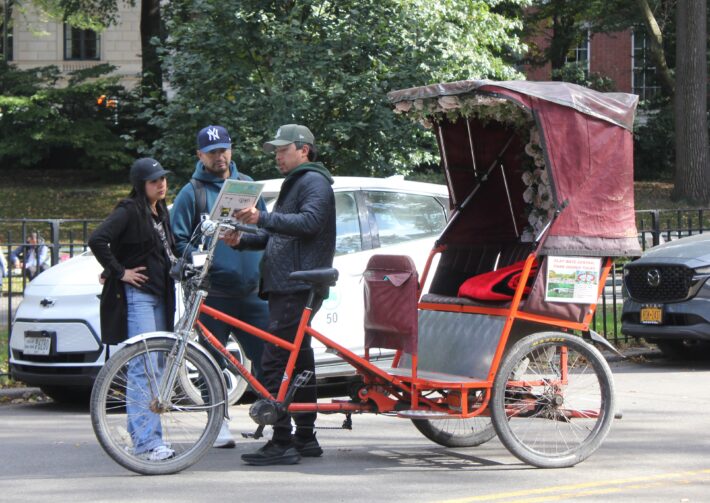
Kenneth Winter usually pedals into Central Park before 8 a.m., but he isn’t there for the exercise. He’s a pedicab driver starting a workday that often lasts more than 12 hours. Those hours have grown longer in recent years, he said, as unlicensed drivers have flooded Midtown’s streets, overcharging riders and crowding out veteran operators.
Now, after years of growing complaints from tourists, businesses, nonprofits and licensed drivers, the City Council is considering bills that would tighten regulation of the industry and crack down on drivers who overcharge unsuspecting passengers. Longtime drivers like Winter support the rules, but only if the city follows through with strong enforcement. Whether it will is an open question: a proposal to move oversight to the Taxi and Limousine Commission (TLC) faces resistance from the agency itself.
The Midtown Community Justice Center, a community court that handles pedicab tickets, estimated in a May report that as many as 1,500 drivers could be working the city’s streets. The Department of Consumer and Worker Protection (DCWP) testified at an Oct. 7 hearing that only 600 are licensed, though it can grant up to 850 licenses.
“Obviously, it’s extremely out of whack,” said Danielle Mindess, the center’s project director.
The imbalance could matter more soon. David Saltonstall, vice president at the Central Park Conservancy, said a coming ban on horse carriages in the park will push more tourists towards pedicabs, making the regulations especially important.
The city already requires drivers to get a DCWP license, carry personal liability insurance and to post ride prices on their cabs. In Winter’s experience, those rules are rarely enforced. “All the enforcement fell away after the pandemic,” he said, adding that many drivers stopped paying for their insurance and licenses.
The city is trying to enforce the rules: NYPD criminal summonses against pedicab drivers rose from 533 in 2019 to 1,710 in 2025. But, according to Mindess, “the vast majority” of these summonses are dismissed in court because the officers rarely present evidence against drivers, a requirement for summonses that could lead to jail time.
“Pedicabbing has turned into the new gold rush,” said Winter, 56, who’s driven for 24 years and is director of external affairs at the New York Pedicab Alliance, an advocacy group of longtime drivers.
The current pedicab industry is “easy and quick money,” said one driver parked near a garage on West 44th Street, who spoke on condition of anonymity. He’s been driving for two years and claimed to have a license, but his name did not appear in a database of licensed drivers released last November or a list of license applications submitted to DCWP after January 2023. He said he charges $9 a minute for a ride and acknowledged that “some of us are just scamming the people” who take pedicabs.
The bills aim to close that opening. Under the proposed rules, the city would set per-minute prices, and drivers would have to use meters that display the cost of a ride in real time. Drivers would be barred from parking within 50 feet of theaters and from playing loud music. Tickets would no longer carry a possible jail sentence, allowing courts to address summonses without NYPD assistance. Council member Gale Brewer has also proposed moving oversight of pedicabs from the Department of Consumer and Worker Protection to the Taxi and Limousine Commission.
Longtime drivers largely welcome the changes. “We’re open to anything that’s going to right the industry, as long as it doesn’t have an unintended consequence,” said Winter. He and the Pedicab Alliance support most of the rules, except for the ban on theater parking. “You’re only pushing the problem 50 feet away,” he said.
Mo Tokh has been driving pedicabs for three years after immigrating from Tajikistan. The proposed rules are “a great idea for customers and drivers,” he said. He has a license, but frequently sees unlicensed drivers on the streets and said that they’ve driven customers away from legal drivers by charging high rates for short rides.
Local businesses also back the legislation. Tom Harris, president of the Times Square Alliance, called the current state of the pedicab business “the Wild West” and welcomed a chance at a reset.
But how well the rules work will depend on who enforces them.
“TLC, in my opinion, and the opinion of a lot of other people smarter than me, is the logical place,” said Harris. Winter agreed, saying “TLC does have the resources to be able to carry out enforcement. DCWP has a certain amount of officers, but they can’t always be on the street.”
The Taxi and Limousine Commission disagrees. In testimony to the City Council, Deputy Commissioner Ira Goldapper said that “pedicabs operate under a different model and regulatory framework” than taxis, making the TLC ill-suited to regulate them. “This legislation would be extremely costly to implement, going well beyond existing resources,” he added.
Harris and Saltonstall said their organizations would fight for more funding for TLC oversight of pedicabs in next year’s budget negotiations. “We have to give them the resources, and no one is asking them to do more with less,” said Harris.
Brewer has been talking with the agency after hearing Goldapper’s concerns. “I know that they’ll come around,” she said. “When I spoke to [TLC Commissioner Midori Valdivia], she wasn’t against it.” Brewer said she expects a City Council decision on the pedicab bills before January. The Department of Consumer and Worker Protection declined to comment.
Winter is optimistic about the vote, but emphasized the importance of solid implementation. “Nothing means anything if there’s not enough enforcement,” he said.