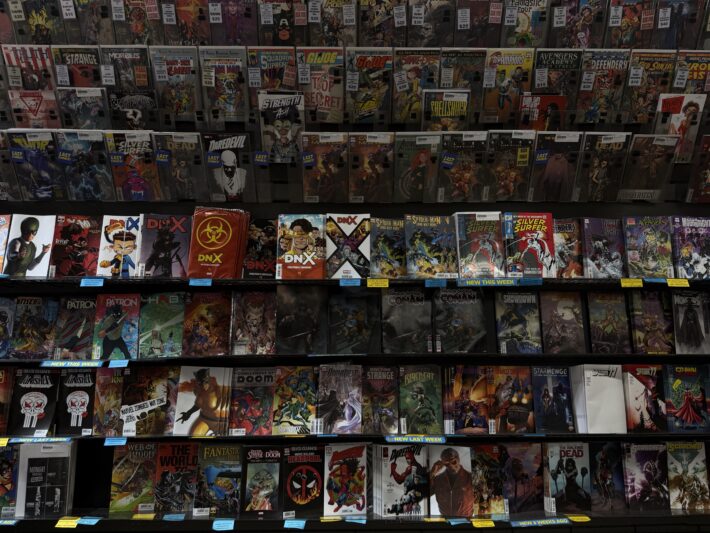
Every Wednesday for the past several years, 63-year-old Armando Diaz has browsed the shelves of Midtown Comics in Times Square on new release day. He’s been doing some version of this ritual since 1969, long enough to remember when Marvel Comics filed for bankruptcy in 1996. These days, he can barely get through the new arrivals shelf before it’s picked clean.
“I’m a nut about comics,” Diaz said.
Across the city, comic book retailers are astonished by their stores’ newfound popularity. Nationwide, shops like Midtown Comics grew by 21.7% during the spring and summer of 2026, on top of roughly 30% growth throughout 2025, according to recent industry data presented at this year’s Comic-Con. Sales of manga, the comic books and graphic novels that originate in Japan, also climbed 40% since last year. After 15 years of stagnancy and competition from e-commerce, stores in Midtown Manhattan, home to two Midtown Comics locations and the manga-heavy Kinokuniya bookstore, say they’re in the middle of a boom, driven by hit series, a new generation of readers, and a community the stores have spent decades building.
Gerry Gladston, chief marketing officer and a self-described “founding father” of Midtown Comics, has watched the two-story shop on West 40th and Seventh Avenue grow since it opened in 1997.
He credits the surge to the 2024 launch of DC Comics’ Absolute series, which reimagined the publisher’s best-known superheroes in a separate, self-contained universe. Unlike series weighed down by more than 80 years of backstory, Absolute requires no prior knowledge, giving newcomers an easy way in.
“Absolute Green Arrow really took off like a rocket,” Gladston said. A signing with the author drew about 200 people, he said, many of them young and new to collecting.
Diaz, a fan for more than five decades, said quality matters just as much to long-term fans and first-time readers. “You can’t get away with mediocrity anymore,” he said.
Milton Griepp, editor-in-chief of ICv2, a comics trade publication, and a leading comic book market analyst, agreed. “If it’s a bad story, it doesn’t matter how cheap it is, or how great the package is,” he said. “People won’t buy it.”
Still, Griepp speculated the moment may represent more than the success of one comic series. “It has the feel, perhaps, of being something long and significant,” he said.
He attributes much of today’s growth to Gen Z readers, who were isolated during the COVID-19 pandemic and prefer physical, collectable products. “Gen Z seems to be interested in analog experiences. They’re very drawn to community,” he said, adding that a comics shop gets them out of the house, among fellow fans, and sends them home with something they can hold. “People were deprived of community so much during those COVID years, and now they crave it.”
Griepp said longer-term changes created the conditions for the sales surge. In the 1980s, American comics were aimed largely at teenage and young adult men. Starting about 20 years ago, major publishers began working to expand their audience to include more women, hiring more female creators and toning down the “overt sexualization of characters,” he said.
Michelle Peluso, an associate sales manager at Midtown Comics, remembers when women weren’t as welcome as they are today. The stereotype of a woman entering a comics store and “all the guys immediately stopping and staring was unfortunately real,” she said.
Manga, which had long catered to a broader audience, was the first comic book genre to reach readers who “maybe aren’t interested in the action genre,” Griepp said. Such titles drew adult women, teens, girls, and LGBTQ readers. Then came the pandemic and a boom in anime streaming, which “just turbocharged everything,” he said. Today, American graphic novels, whose sales are outpacing single-issue comics, increasingly serve those same groups.
Peluso said the rise of manga “allowed people to be like, ‘Oh wait, different kinds of comics can be different kinds of things.’”
The change reaches behind the counter too. Fans who once felt out of place in comic shops now help run them. Peluso, for one, has the title to prove it.
“Hi, I’m one of the managers for this company,” she joked.