Alex Obando spends most of his workdays outside in Midtown, picking up shifts cleaning oil spills. People tell him to get some fresh air, but “sometimes you can’t even really do that, especially around here,” he said.
The shortage of trees may be one reason. Since 2015, the Parks Department has completed 1,855 work orders to remove trees across Midtown and only 1,608 to plant new ones. The neighborhood already has some of Manhattan’s lowest tree cover and some of its most polluted air. And since 2024, residents can no longer request a replacement tree through 311. Instead, Parks surveys one neighborhood at a time on a nine-year cycle.
Those trees add up to what is known as canopy: the share of the ground covered by leaves and branches when seen from above. And Midtown doesn’t have much of it. From 2017 to 2021, the city council districts covering Midtown West and Midtown East had canopy cover of just 11% and 13%, among the lowest in Manhattan, according to The Nature Conservancy. That’s well short of the city’s goal of 30% citywide by 2040.
Trees help clean the air, said Samuel Bishop II, arborist specialist and director of education for the nonprofit Trees New York. Particles floating in the air settle on a tree’s leaves and bark, he said. “Then they get washed off at the next rain, so that they’re not blowing around in the air.”
But with three major transit hubs — Grand Central, Penn Station and the Port Authority — and constant heavy traffic, Midtown has a lot of those particles. This fine particulate matter, microscopic specks from vehicle exhaust and other sources, can lodge deep into the lungs. According to the city’s Environment & Health Data Portal, Midtown exceeds the federal annual limit for particulate matter, while nearby neighborhoods with more tree cover, such as the Upper West Side, have lower levels.
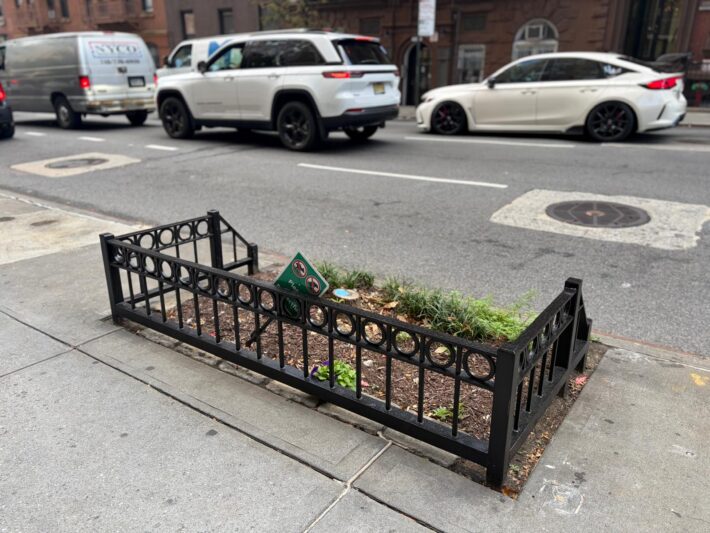
Some residents say the new system leaves them with no way to push back. At the Manhattan Community Board 6 Parks & Cultural Affairs Committee’s Sept. 1 meeting, Midtown resident Nicole Giacco said the city cut down a tree on East 36th Street that was young and healthy. She said the Parks Department removed it because it stood too close to a street sign. NYC Parks did not respond to questions about why the tree was removed.
“If we’re trying to increase canopy, why wouldn’t we just move the sign, cut a branch?” Giacco asked the committee. Under the new system, the empty tree bed on East 36th Street may not be filled until 2030 at the earliest, according to NYC Parks’ 9-year cycle map.
NYC Parks says the shift away from 311 requests will get trees to the neighborhoods that need them most. According to a Parks’ press release, the city planted 18,261 trees in fiscal year 2026, the most since fiscal year 2016.
“The plan is for us to make sure that we’re equitably targeting every single corner of the city in accordance with heat mitigation, canopy cover, variety of needs,” said Nicholas Zito, deputy director of tree planting at the Parks Department, at the Sept. 1 meeting.
According to Zito, as of 2024, every spot where Parks could plant a tree in Manhattan Community Board 6, which covers East Midtown, already had one.
“Obviously, there’s storms that have happened since then. Trees fall with old age; they’re taken down,” he said, recognizing that new planting spots may have opened since then. “But as of 2024, we’re fully stocked.”
Manhattan is especially difficult to plant in because of what lies beneath its streets, Zito explained. Some spots that look empty to passersby have already been reviewed by a Parks forester and ruled out, he said. “If a tree was not planted there, it was for a very specific reason.”
Bishop, the Trees New York arborist, said those reasons are often underground. Gas, electric and telephone lines can run beneath tree beds, and Parks avoids planting over them, he said. If a line needs repair, the tree often has to come out, and a tree blown over in a storm could damage the line.
For Obando, who works outside, the tree shortage is hard to escape. “They should definitely put some more trees,” he said. “I mean, who doesn’t love Mother Nature, you know?”