On Sept. 2, Mayor Zohran Mamdani and Schools Chancellor Kamar Samuels announced a one-year moratorium on public school students’ use of generative AI in 2-K through eighth grade, with exceptions for accessibility tools. But the rules are more complicated for high schoolers.
The new policy limits how public high school classrooms can use AI. Private schools operate under their own institutional policies. The result is a widening gap, educators and researchers say, between students with the resources to develop AI literacy on their own and those who depend on their schools to teach it.
“AI’s gonna create a massive divide between the people who know how to use it and the people who don’t,” said Isaiah Panton, a public school sophomore at the Clinton School. “Unless you are curious about AI or self-taught like me, you don’t get to learn anything.”
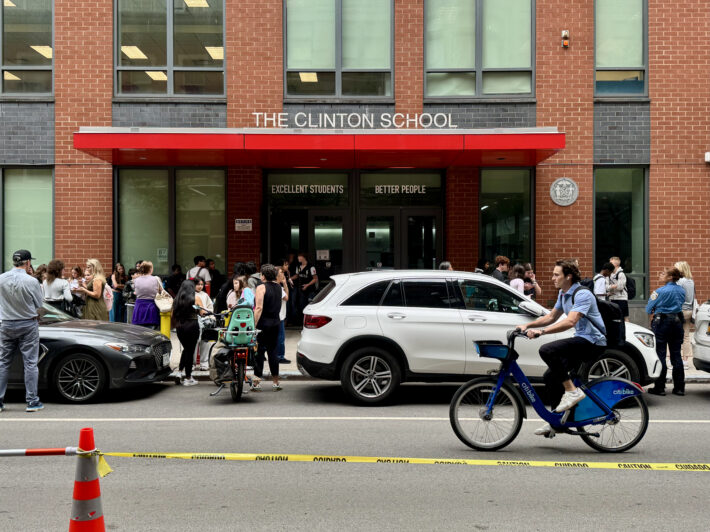
Clinton, located near Union Square, is one of the few New York City public schools that provides the International Baccalaureate (IB) Diploma Program — a rigorous international curriculum built around long-form essays and independent research — to all students. Principal Jonathan Levin said the school’s approach to AI has been shaped by IB’s 2023 announcement that it would require students to credit and reference any AI-generated material used in their work, but would not ban the software.
Levin had planned to introduce advanced AI curricula for high school students, but the Department of Education’s new policy allows AI use only in two 45-minute AI literacy modules, teacher-supervised career-readiness programs, and five pilots that have yet to launch.
“I think it flies in the face of reality. We jokingly call it AI abstinence,” Levin said. “It doesn’t work with sex, drugs, and it’s certainly not going to work with AI.”
Levin said he understands concerns about academic honesty but wants to prepare students for a world where employers require AI skills. He is interested in the DOE’s planned pilots, which will let up to 50,000 students, about 5% of public high school enrollment, use vetted AI tools in controlled settings.
At a City Council meeting on Sept. 15, DOE representatives said they hope to launch the pilots in November, though they have not set a date. Parents at the meeting said they worried the pilots would be tested on their children. Cheri Fancsali, who heads the New York University-based Research Alliance for New York City Schools, cautioned that pilots tested in unrealistic settings might not produce results that hold up in typical classrooms.
Fancsali said that with nascent research on AI’s effects on learning, schools must balance concerns about students substituting AI for their own thinking with preparing them for a workforce that increasingly demands AI literacy. “The expectation is that they not only understand it but are able to leverage it in their work.”
What follows remains unclear, but the Technology in Schools Coalition, made up of students, parents, teachers, and other stakeholders, will deliver policy recommendations in April.
Figures from NYC’s Independent Budget Office show that in the 2024-25 school year, 906,248 students attended the city’s public schools and 227,816 attended private and parochial schools. While many of these students have access to guidance and AI tools at home, others rely on their school’s policy for AI education. “It’s not just a gap between public and private,” said Fancsali. “It’s a gap between more resourced and less resourced students.”
A few blocks from Clinton, BASIS Independent Manhattan Upper School, ranked No. 3 in New York by Niche, belongs to a national network that built its AI policy with input from students, teachers, parents, and administrators.
BASIS Vice President Toby Walker said their policy distinguishes between learning about AI, student use, and teacher use. It leaves classroom rules largely up to individual teachers, an approach that may have drawbacks, according to Luke Waltzer, cofounder of the City University of New York AI Lab, which develops AI tools and resources for teaching and research.
“I want people who are enthusiastic about using it to be forced to defend their enthusiasm,” Waltzer said, adding that teachers resisting the technology should also ask themselves how that choice is serving their students.
Greater freedom does not necessarily mean BASIS affiliates are embracing AI. BASIS sophomore Michael Hunter said there is a stigma among his peers and teachers around using it, and that, aside from treating it like a search engine, he rarely uses AI. “AI is not very good at what it does,” said Hunter.
Walker said students often turn to AI when they’re stressed or don’t see the value in assigned work. “Busywork is something that nobody should be setting,” he said. “I think of AI as being almost a symptom of a problem, as opposed to the problem in itself.”