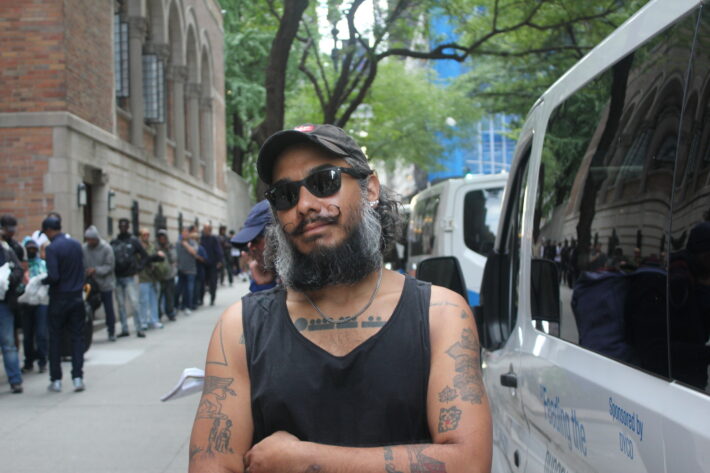
By 5 p.m. most nights, the line outside St. Bartholomew’s Church at East 51st Street and Park Avenue stretches down the block, around the corner, and out of sight. Dinner, served for free, is still half an hour away, but every so often a movement near the door sends a ripple of anxious glances down the line.
Lorrie Feliciano has been standing in lines like these more often since last month, when she lost her food stamp benefits under new federal work requirements, which mandate that able-bodied adults work 80 hours a month to receive benefits.
According to a city comptroller’s report, 118,000 New York City residents lost benefits from the Supplemental Nutrition Assistance Program, or SNAP, between July 2025 and June 2026 as the Trump administration’s new eligibility rules took effect. City officials said that 22,000 lost benefits this past June alone. The cuts are landing hardest in neighborhoods like Midtown, historically the center of the city’s unsheltered population, where soup kitchens are being asked to plug a hole they were never designed to fill.
Feliciano, homeless and in her 50s, has uterine fibroids: benign tumors on the uterus that can have severe side effects. The condition keeps her from working, but she doesn’t have a disability designation that would let her qualify for benefits without meeting the work requirement.
“I’ve been being honest with everyone and telling the truth about my situation,” Feliciano said. “I’d rather go to work, but I don’t work, and I do have medical issues that I go to doctors for.”
Her situation is far from unusual. Eli D’Albora, an outreach specialist for the Coalition for the Homeless, said that some of his clients have lost access to food stamps since the work mandates took effect.
Zach, who declined to give his last name in fear of stigma, usually sleeps on a bench on Manhattan’s East Side. He lost his SNAP benefits at the beginning of the year.
“How do you find a job if all your time is spent trying to get food?” Zach said, adding that he often sees people show up to St. Bartholomew’s Church, known as St. Bart’s, hours before dinner is served.
For others, the anxiety isn’t about finding work but about losing what little stability they have left. Emanuel Valladolid, who’s been homeless for nine years, is bracing for an upcoming recertification appointment that could end his benefits entirely.
“I’m financially struggling,” Valladolid said. “I don’t know what I’m gonna do.” Losing benefits would force him to rely on food banks and other, less reliable ways of finding a meal. “Even if I have to eat out of the trash, I’ve done it before,” he said.
Juan De La Cruz, director of emergency relief at the Coalition for the Homeless, manages the St. Bart’s food bank, where around 400 meals are served each night. “We’re in the beginning stages of this,” he said, referring to people losing SNAP benefits. “I think people are still trying to mix and match and make it work.”
He emphasized that his food production team was already stretched to capacity. “If we could make more, we would make more,” he said.
D’Albora put the situation in starker terms. “We don’t have endless resources for everyone.”
Even if the kitchen could make more, it would do little to fill the gap. Food Bank for NYC, the city’s largest hunger-relief organization, estimates the cuts amount to roughly 75 million meals, the equivalent of its entire annual output, according to Zac Hall, the organization’s senior vice president of programs.
“Soup kitchens, and particularly food pantries and food banks, don’t have the resources to fill in for SNAP,” said Janet Poppendieck, co-founder of the NYC Food Policy Center. The city is trying to help by increasing funding for the Community Food Connection program, which funds food banks, but Poppendieck predicts that any real fix will have to come from Washington. Instead, she expects new federal cost-sharing requirements that began this month, forcing states to pay a greater share of SNAP costs, to lead to further cuts in the future.
For now, those who’ve lost benefits are doing what they can to cope. Feliciano said she’s planning to “just coast for now a little bit and just get this help for now.” She hopes to get her benefits back after an upcoming hearing with the state’s disability agency. In the meantime, she’ll keep lining up outside St. Bart’s every night, hoping the supplies stretch far enough for another night’s meal.