For the past seven years, local residents near 54th Street and Broadway have struggled to get the Department of Buildings to properly address issues with a digital LED billboard they say is disrupting their quality of life.
The sign shines bright light into apartments, making it difficult for residents to live and sleep. After years of filing complaints and working with the local community board and elected officials, residents are suing the Department of Buildings for transparency about the billboard’s compliance.
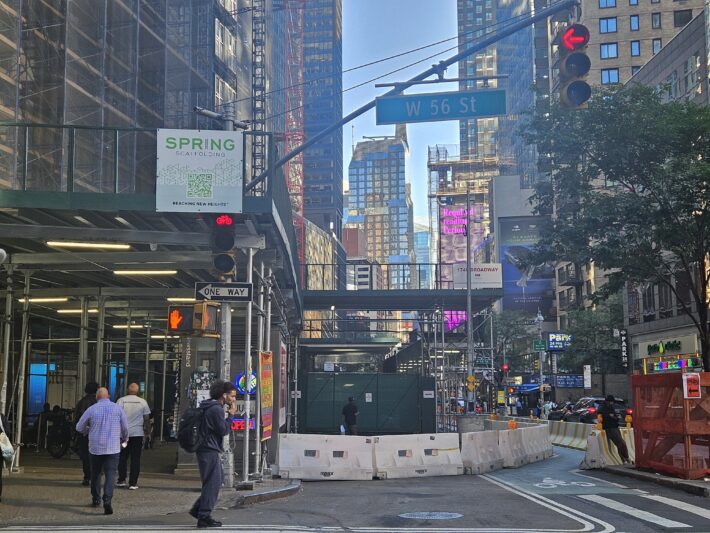
“Even if I closed my blinds, you can still see the light hitting my wall,” said Andrew Campbell, who lives in a high-rise apartment at 56th Street and Broadway with windows facing the sign. “I had my TV on one side of the wall and had to move it, because the brightness coming in through the window was just too bright. I couldn’t use the television.”
Another resident of the same building, who wished to remain anonymous for privacy reasons, described the sign as an “extreme form of light pollution.” The resident has lived in the neighborhood for more than 10 years, since before the sign’s installation in 2017. “At times the light continued flashing through my closed eyelids, making it impossible for me to sleep. It is unnecessary, invasive, and potentially harmful to residents’ health and well-being,” they said.
The West 50s Neighborhood Association filed the suit on behalf of nearby residents. It seeks public records from the Department of Buildings on its enforcement of signage rules against the sign, which is owned by the advertising company New Tradition Media. The residents hope the lawsuit uncovers documents they can use as evidence to strengthen their case for proper enforcement.
“When the [public records] requests and appeals get collected, it leaves a record that can then go to the elected officials,” said Jacob van Winkle, treasurer of the West 50s Neighborhood Association and head of the campaign. “The elected officials can look at what the Department of Buildings is doing and then decide to correspond with them, agency to agency.”
On May 11, 2026, City Council Member Gale Brewer wrote to the Department of Buildings on behalf of residents, pressing the agency to act on the sign. The department opened a new inspection and audit, which concluded in August. On Aug. 27, Department of Buildings Commissioner Ahmed Tigani responded that the “illuminated sign does not exceed standards,” but his letter did not specify which standards or regulations the audit had examined.
The conclusion contradicted the department’s own records. Public records the association previously obtained show that the department cited the same sign for violating Zoning Resolution Section 32-64 in a 2024 audit. It’s unclear how that earlier violation was resolved.
On Sept. 11, Council Member Brewer sent a follow-up letter pressing the agency on that point, asking the department to specify how the sign complies with Section 32-64 and setting a 30-day deadline to respond. Brewer noted that the provision governs light projecting onto residences, not hotel rooms. The provision requires that “any illuminated sign does not project or reflect on residences… so as to interfere with the reasonable use and enjoyment thereof,” according to the city’s Zoning Resolution.
During the audit, the Department of Buildings told New Tradition Media about resident complaints about light trespass, and the company agreed to reduce the sign’s brightness during specific morning and evening hours.
“Please note this reduction in brightness is voluntary rather than an enforceable agreement,” said David Maggiotto, the department’s senior press officer. New Tradition Media did not respond to a request for comment.
Maggiotto said the audit concluded the sign did not violate zoning rules based on “submitted evidence that the sign did not block any of the light or ventilation of any hotel rooms.” The sign, attached to the Ameritania hotel, is across the street from a Residence Inn by Marriott.
Asked how the audit addresses Section 32-64 and the light projecting into residences, Maggiotto reiterated, “The results of the audit determined that the illumination did not violate the Zoning Resolution.”
Council Member Brewer said in an email that she has called the department to follow up on her letter, but has not heard back. The department has not responded to the September letter, missing the 30-day deadline.
The lawsuit seeks records on the sign’s original approval and the department’s review of subsequent plan revisions, documents the association sees as central to understanding how an installation that has drawn complaints for seven years was permitted in the first place, and how it has stayed up since. The lawsuit is scheduled to appear in court on Nov. 16.
Meanwhile, residents say they had assumed nothing could be done.
“I wasn’t even aware that anyone was doing anything about it,” Campbell said when asked about the campaign. “I thought [the bright light] was just one of those things that I was going to have to live with.”