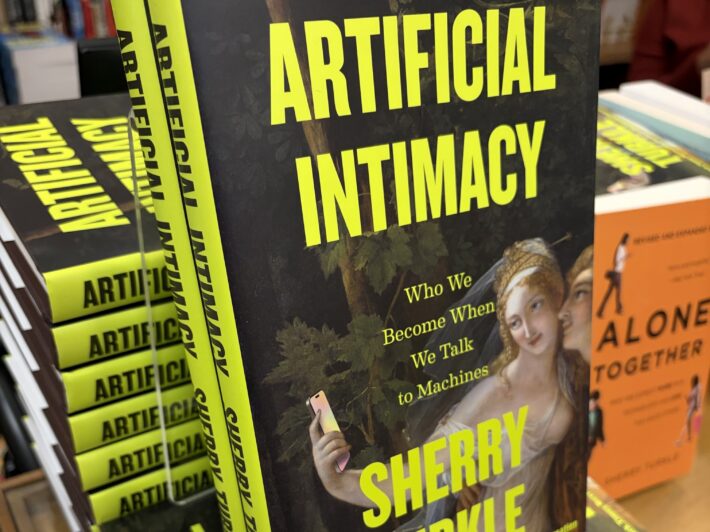
Author and sociologist Sherry Turkle told a Brooklyn audience that AI chatbots can’t replace human connection.
Turkle spoke with New York Times reporter Kate Zernike at Greenlight Bookstore in Fort Greene on Oct. 7 about her new book, “Artificial Intimacy: Who We Become When We Talk to Machines,” in which she warns readers against seeking comfort and companionship from chatbots. Turkle said at the event she hopes the book helps build a movement of people who say, “this is just not right.”
Every seat was taken at the event, and dozens stood in the back. Attendees from baby boomers to Gen-Z chatted quietly before the talk began, many holding copies of Turkle’s book.
Owen Watson, a bookseller and co-host of the event, said Greenlight hosted the talk because “we’re a community space.” As an independent bookstore, he said, it wants to stay “at the forefront of critical awareness of technology.”
For Turkle, the event was personal. She was born and raised in Brooklyn and said that Greenlight was a special first stop for her book tour. Back after a long absence, she said, she “felt all the feelings.’”
The audience Q&A focused on whether AI can help people who are lonely.
Sonali Verma, 30, felt the crowd leaned anti-AI, so she spoke up to defend its use as a therapist. Verma, who said she once worked on the AI diagnostics team at Google Health, now works in AI diagnostics at a non-profit health access initiative.
“I think access needs to be a part of the conversation,” she said. “Some people simply don’t have access to a therapist because of the cost.”
Verma said Zernike’s questions for Turkle brought nuance to the conversation, but she wanted to hear another side of it. During the Q&A, she asked if AI can ease what many call a “loneliness epidemic,” then how can that be negative.
If she had the money it takes to build one data center, Turkle said, she could build a social infrastructure that would alleviate the loneliness of people who feel they have no choice but to talk to a machine.
“I think it’s an abandonment of each other when we can think of no other option for people,” Turkle said.
A June 2026 Pew Research Center survey of more than 5,000 U.S. adults found that 20% of adults ages 18 to 29 use AI chatbots for emotional support or advice, and 7% use them for companionship.
Davis Erin Anderson, senior digital security trainer at Freedom of the Press Foundation, said the conversation reinforced a mission she’s been pursuing for years: changing how people talk about AI so chatbots aren’t treated like people.
AI is inauthentic in its nature and should be used as a tool, Anderson said, not as a replacement for human intimacy.
“AI lacks the ‘between the linesness’ that is innately human,” Anderson said, in an interview after the event. “The friction is where we learn.”
Turkle was careful not to reveal too much of her book, admitting that she wants people to purchase it. But she had a message for those who want to push back on the personification of AI chatbots and feel lost in how present it has become in their friendships, families, and the world around them.
“It’s time to not feel apathetic,” Turkle said. “The moment calls you. Reality needs you, your family needs you, this moment needs you.”