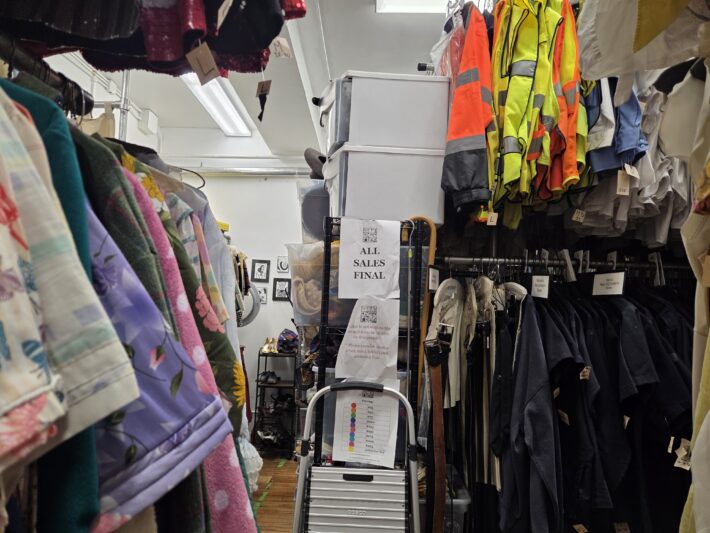
When Antonia Xereas and Kaela Wohl opened Alias Costume Rental in 2009, they bought inventory from another Manhattan rental house that had gone out of business. Seventeen years later, Alias is doing the same: selling off its own stock, piece by piece, to anyone who will come buy it. At the end of 2026, their shop —the last professional costume rental house in Manhattan— will close.
Alias’s closure leaves Manhattan without a centrally located source of specialized rental costumes for New York production designers, even as New York state’s film, television, and theater production has rebounded. For designers and stylists on New York-based productions who depend on last-minute access to specialized inventory, the only choice now is a trip to Queens or Yonkers.
“There’s been some moments where it’s been a little difficult,” said Xereas. “I’m like, ‘There’s another memory walking out the door.’”
When Odds Costumes rental house closed its doors in 2009, Xereas and Wohl were both working as costume designers for sketch comedy. “We had these cool jobs where we knew we needed weird costume stuff all the time and very last-minute,” said Wohl.
Deciding they needed to save at least part of the inventory, they bought a portion of Odds’s inventory to add to their own preexisting collections and opened Alias. Their inventory specialized in uniforms, workwear, and theatrical costumes as well as shoes and accessories for professionals to rent.
Seventeen years later, the stretch leading up to their own closure has been difficult. Alias broke even most years. But the 2023 writers’ and actors’ strikes disrupted film and television productions, making an already precarious business harder to sustain. “We kind of lost money for, I’d say, a year and a half straight,” said Xereas.
Xereas then lost her job of 11 years when The Late Show with Stephen Colbert ended in May 2026. Wohl also moved to Wisconsin. “After 17 years, we both kind of felt like we didn’t want to live through another downturn in the industry, and now that things are actually booming, maybe the timing to go out is actually perfect,” said Xereas.
“Oh my God, when I saw the announcement that they were closing, I f——- screamed,” said costume designer Ashley Soliman. “I’m like, where else is there to go?”
In her 12 years in the industry, Soliman has turned to Alias for everything from operas to musicals, drawn by a small shop packed with specialty inventory and a Herald Square location that let her hit the jewelry and garment districts in a single afternoon. “The thing that I always loved about Alias was that for such a tiny place it was packed with a little bit of everything you needed,” she said.
Those who depended on Alias the most were often stylists working on commercials, where requests tend to come in last-minute.
Stylist and costume designer Nadya Laska has worked on commercials for brands like Nike and Bape, often pulling items from Alias for shoots.
“I once had a commercial with five different vintage suits, and it was all last-minute requests with no sizes,” said Laska. “Those are the things that I can’t spend a day going to Long Island City for or send someone out to go to Long Island City for, so in that way Alias definitely saved me.”
Without Alias, Laska said the only option for quick turnarounds is now Amazon. “Which is really a bummer,” she said.
New York state film and TV production spending rose 87% last quarter, compared with 17% in California, according to an Oct. 15 report from the industry tracker ProdProd. But while California has 10 to 15 union costume rental houses, New York only has one in Yonkers.
That gap is a problem Carisa Kelly, a costume designer and founder of the Garment District revitalization nonprofit The ReThread Project, keeps running into. “Very few of the productions here have the resources to be able to be sending everybody to LA and overnight ship,” she said. The ReThread Project estimates that about 62% of fashion and costume industry production jobs are located in Manhattan, with 20% in Brooklyn and 12% in Queens.
Last year, while working on an indie film, Kelly needed official U.S. Postal Service patches for a postman character with little time to get federal approval to purchase them. Alias had them in stock. “We’d already been looking at Alias, and we knew that they had them, and we went and just rented all of them,” she said. “We wouldn’t have been able to do that scene [without Alias].”
Helen Uffner has watched the district shrink in real time. She started Helen Uffner Vintage Clothing in 1978, when about 10 large rental houses operated in Manhattan. She is now one of the few left in the city, alongside the Theatre Development Fund’s Costume Collection in Astoria. Rising rents pushed her out of the Garment District, and after five moves over five decades, her shop also landed in Queens, in Long Island City. “It’s a shame that we can’t afford to be in Manhattan anymore,” she said.
For designers still relying on rental shops, trips outside Manhattan can be physically difficult.
“Clothes are heavy. An industrial rack of clothing can weigh up to 800 pounds. That’s heavy,” Kelly said. “So just think of the scale of what you’re asking — generally women— to carry all over the city. And to do it on a subway, without a car, without subways that have elevators.”
Gerald Scupp, vice president of the Garment District Alliance, which represents property and business owners in the neighborhood, said the alliance has to balance the competing interests of property owners, business owners, and the public. “They tend to cast a blame on property owners for raising rents, but I think that’s a little bit of an oversimplification,” he said. Scupp said the alliance has supported the garment industry over the years, but it can’t legally favor one industry over another.
Xereas and Wohl tried to sell the business; they couldn’t find any takers. A full costume rental collection can cost millions of dollars, Wohl said. That’s excluding the cost of storing it. “Even when Odds was closing we never could have afforded to just buy the whole thing, we could only buy this chunk that we wanted.” In its last days, Alias is slowly selling off all of its stock. While some productions have bought up niche inventory, like all the store’s pregnancy bellies, most pieces are being sold to individual members of the public.