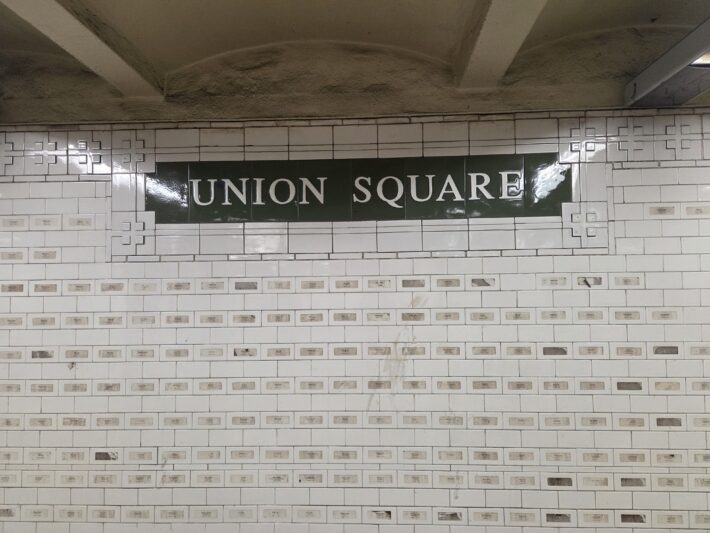
Walking down the long hall connecting both ends of 14th Street Union Square Station, it’s easy to miss the transparent stickers stuck to some of the corridor’s rectangular white tiles. A closer look reveals a makeshift memorial fading with time. The stickers show the names and hometowns of the 2,977 victims who died during the terrorist attacks on September 11, 2001. Now the artist behind the tribute, John Lin, is coming forward for the first time, hoping to gather support to preserve the memorial.
“I had been aware of the decay through the years, but it was getting to a point where so many of the names became illegible,” said Lin. “I felt I needed to draw attention to the memorial in order to convince the MTA to grant permission to rehabilitate the memorial.”
Union Square Station is one of New York City’s busiest stations, with more than 24 million riders passing through in 2025 alone. Despite the heavy foot traffic, the memorial has mostly withstood the test of time, but not without some wear.
In 2002, Lin and 16 friends set up the memorial to mark the one-year anniversary of the attacks. Out of respect for the victims and their families, Lin had deliberately kept himself anonymous. But after noticing that some victims’ names were illegible or were fully erased, he came forward hoping to gather support for its rehabilitation.
Over the years, friends and family members have scribbled notes next to their loved ones’ names on the memorial. One label, that of Patrick J. Brown, a highly decorated FDNY firefighter, bears more notes than most.
Artist Sharon Watts met Brown in a karate class in 1995, and they grew close. They were even engaged briefly before deciding to remain friends. “I called right before 9/11 to see if he wanted to grab dinner that Tuesday,” she recalled. “He said that he couldn’t meet me for dinner because he had to work.” Brown died rescuing people on Tuesday, Sept. 11.
The impromptu memorials that sprang up across the city after the attacks inspired Watts to write a book about Brown. She reached out to anyone who had left him a note. “I learned how very personal these memorial notes can be,” she said. “It’s almost like a little spiritual message, like they’re communing with him through these memorials.”
Unlike other makeshift memorials, the one in Union Square has survived. “It moved me incredibly when I first saw it, and I think I was even more moved to know that it still exists. I mean, I almost cried when I heard and thought, ‘Oh my God, I got to get down there tomorrow, and I need to see it again,’” said Watts.
Flatiron resident Amy Elisabeth Spasoff lost her friend Alicia Titus on September 11. “She was a pledge sister of mine in my sorority in college,” Spasoff said. Titus died aboard United Airlines Flight 175.
Spasoff uses Union Square Station the most. “The first time I saw it was probably the first time I used that station,” she said. In the four years since she moved to New York, Spasoff has made it a routine to stop at her friend’s label to kiss her fingers and touch them to the tile. “The minute I turn onto that corridor, I instantly think of her.”
The National September 11 Memorial & Museum, part of the World Trade Center complex in downtown Manhattan, has been in intermittent talks with the MTA about the Union Square memorial for nearly a decade. In 2018, the MTA reached out to Jan Ramirez, chief curator at the museum, to ask whether she and her colleagues would come to unofficially look at the tiles.
After their review, Ramirez and her colleagues recommended that the MTA commission a formal conservation survey. “They said we’ll get back to you,” she said.
Follow-ups came sporadically. Ramirez’s last conversation was in 2024, after the museum’s VP of conservation, who is also an adjunct faculty member at NYU’s conservation graduate program, raised the possibility of turning condition inspections into student learning opportunities. “Over the years, many who had been involved in these cordial exchanges … started to retire and/or take new jobs,” Ramirez said.
The current status of any official preservation plans is unknown, but the MTA said it has “no intention of removing the memorial at 14th Street.”
Ramirez believes the memorial’s fate may be decided when the MTA carries out a broader renovation of Union Square Station. As the MTA struggles to regain pre-pandemic farebox revenue, Ramirez said it’s easiest for the MTA to cut back on its arts program while focusing on other urgent priorities.
In the months leading to his announcement, Lin prepared sketches of a proposed work plan to preserve the memorial. He wants to restore the faded names and then affix plexiglass over the tiles to protect the labels. Lin plans to set up a nonprofit for the memorial and build a website with his proposal and a donation page.
Meanwhile, until a decision is made about its fate, the memorial continues to slowly fade.