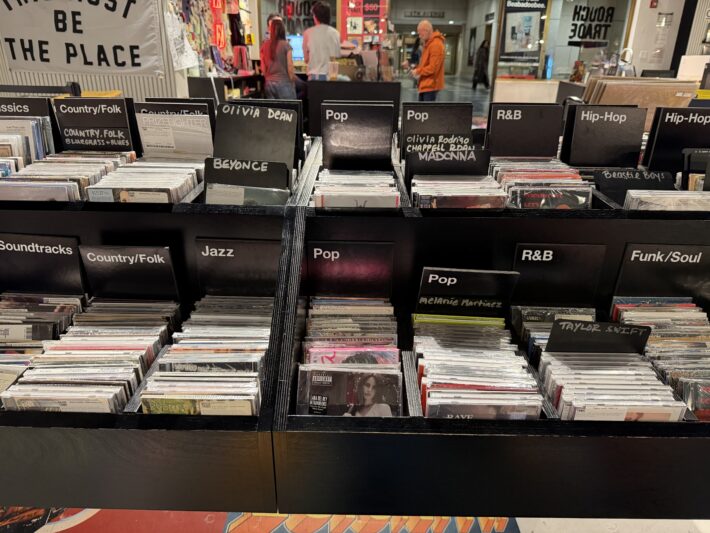
On some Saturdays at Academy Records & CDs in Flatiron, the shelves are full in the morning. By closing time, they’re empty.
“Now that people are buying a lot more CDs, it just goes so fast,” said Nadia Stoddart, a cashier who helps buy stock for the secondhand music store at 12 W. 18th St.
The compact disc, written off for years as a casualty of streaming, is making an unexpected comeback. Midtown record stores say young shoppers are leading it.
The numbers back it up. In the first half of 2026, U.S. CD revenue rose 58.6% from the same period last year, to $171 million, according to the Recording Industry Association of America. Luminate, the data company behind the Billboard charts, which tracks sales at the register, counted 24.8 million CDs sold through September, up 11% from a year earlier. In the New York market, the number sold rose 17% over the same period.
At Rough Trade in Rockefeller Center, store manager George Flanagan estimated that CD sales are up at least 35% from last year.
“They didn’t see the death of CDs,” Flanagan said of his younger customers. “The same allure that the tactile experience of vinyl has had for people that didn’t grow up on vinyl is now hitting that generation for CDs.”
At Academy, the number of CDs sold has long been steady, said Mick Collins, a collections appraiser. What has changed is who buys them. “The market seems to have gotten very young, which is fascinating,” he said.
Collins sees two reasons. Every generation, he said, is drawn to the music of the years just before it was born, and the music of the early 2000s lives mostly on CD. The other is ownership. “Once you buy it, you own it,” he said. “It can’t be taken away from you.”
That appeal extends beyond New York. Rebekah Hampton, 29, a retail worker in the Texas Panhandle, collects CDs by Taylor Swift, Sabrina Carpenter, Kelsea Ballerini and Miley Cyrus, often pre-ordering them straight from the artists’ websites. Streaming platforms can put music behind paywalls or remove it entirely, she said in a direct message on TikTok, but “the certainty of holding a physical album in your hands negates any worry of losing your tunes.” Hampton hasn’t given up streaming, which she said is still the most convenient way to keep up with the many artists she follows, but “collecting CDs ties an invisible string between my past and present.”
Price matters as well. CDs are cheaper than records and easier to fit into a small apartment, Stoddart said. In the store’s sales rankings, CDs have climbed from the top five categories to the top three, she added.
“CDs are more affordable than vinyl,” said Hampton, adding that inflation has pushed up record prices and shipping costs. She has started thrifting for discs, too. “It’s a rush to find a favorite album for only $2.”
K-pop is another driver. Its fans often buy several versions of the same album to collect the photo cards inside, said Matt Bass, vice president of research and economics at the Recording Industry Association of America.
“BTS’ ARIRANG album was a leader in this mid-year surge, with K-pop fans especially known for supporting their favorite artists through physical products,” he said. K-pop made up more than 17% of CD sales this year, said Alexandra Chan, a music insights manager at Luminate.
Many young buyers have nothing to play their discs on. About half of Generation Z and millennial CD buyers don’t own a CD player, according to Luminate. Its survey data show they buy CDs to support artists and to display as collectibles.
Collins said Academy is getting more requests for CD players, but he also hears shoppers leaving with stacks of discs muttering, “Oh, now I gotta find a CD player.” Others come prepared. Stoddart said customers tell her they just bought a Walkman, or show up with a portable player around their neck.
Some buy strictly to listen. “Something you wanna hear, you just pop it in and keep it moving,” said Joseph Isbell, a longtime CD buyer, outside the Academy store.
Not every store is feeling it. At Jazz Record Center on West 26th Street, CD sales have been “rather flat,” said Fred Cohen, who opened the store 43 years ago. He waited to stock them, he said, to see whether the format had “staying power.” Stores that sell rock, hip-hop and pop may be seeing more, he said.
Whether the boom lasts is uncertain. Streaming still accounts for 82% of U.S. recorded music revenue, according to the RIAA. Bass said the CD’s momentum “will depend on the broader cultural interest along with investment from artists and labels.” Because K-pop is such a large share of sales, a slower release schedule could affect growth, Chan said. But more non-K-pop artists are using CDs as part of their release strategy, she said.
For Stoddart, the appeal is simple. Songs “can get taken off of streaming at any point,” she said. “But with a CD, they kind of have to come into your house to take it.”