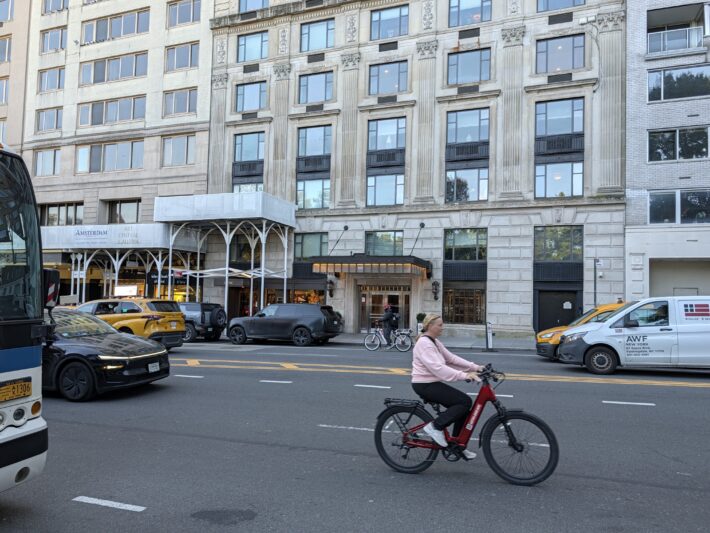
Zack Youngren, an entrepreneur and Brooklyn cyclist, photographed a for-hire driver parked in a bike lane on a busy street during afternoon rush hour and reported him to 311 for unsafe driving on Aug. 31. Two days later, a confirmation said the Taxi and Limousine Commission (TLC) would contact him within 30 days. Several weeks after he filed, no one had. As of Oct. 20, the city’s 311 tracker listed the complaint 18 days overdue.
Youngren is not an outlier. Of the 17,651 complaints against taxi and for-hire drivers filed citywide from February to August, 14,130 were still open as of Oct. 23, according to a Midtown Gazette analysis of 311 data. Complainants have waited a median of about five months, and more than 4,600 have waited longer than six. A year ago, three in ten complaints were still open six months after filing. This year, it’s seven in 10. Midtown accounts for about one in four complaints citywide since July 2025.
Meanwhile, the Taxi and Limousine Commission’s summonses for driving violations have fallen 56% this year, February through July, according to data from the Office of Administrative Trials and Hearings (OATH). But a penalty only works if a complaint reaches a prosecutor, and increasingly, it doesn’t.
Each agency must acknowledge complaints within 30 days. The Taxi and Limousine Commission identifies the driver, a step that can require the vehicle’s owner to name who was driving. A prosecutor then reviews the evidence and can charge the driver or issue a summons. The complainant is contacted only if TLC needs more information or the case goes to a hearing where they must testify.
A driver who pleads guilty pays a lower fine and accepts the points against their license. Six points within 15 months of conviction can bring a license suspension, and 10 points a revocation, TLC said at a March 17 City Council hearing.
Salil Parekh, a consultant, photographed a for-hire car blocking a crosswalk at 1st Ave and East 49th on May 31 and filed a complaint with the photo on June 1. On July 21, the Taxi and Limousine Commission asked him for the license plate number. On Oct. 8, it scheduled a phone hearing for Oct. 14, where the driver pleaded guilty, about four and a half months after the incident. “TLC dragged their feet on my case (which had a picture),” he said in an email.
Cases that reach a hearing have taken a median of about two months from violation since 2021, according to the Midtown Gazette’s analysis of data from the Office of Administrative Trials and Hearings. Daniel Bach, an attorney who represents Taxi and Limousine Commission drivers facing license suspension or revocation, confirmed that timeline, saying hearings take one to two months. Parekh’s case took more than twice as long. The roughly 14,000 open complaints have not reached that stage.
Delays carry consequences for both sides. As stated in TLC’s rule book, concurrent violations must occur within a 15-month period from the first violation in order to start counting towards the new penalty system, and a complaint that sits for months can let earlier convictions age out before a new one is added. For drivers, Bach said, long hours and many passengers mean they can’t always recall a routine incident weeks later, and delays can mean the difference between an accurate and an inaccurate account.
This new rule, adopted in April 2025 to deter repeat offenders, makes a third violation within the 15 months grounds for suspension. The suspension is deferred 60 days, and drivers can avoid it by completing a Vision Zero course, the city’s initiative to end traffic deaths. Violations such as impeding bike lanes, crosswalks, no-standing zones, or double-parking, which once carried no points against a license, now carry one.
Drivers are already “very worried about points,” Bach said, and the rule made it “worse for drivers.”
In the March City Council hearing, James DiGiovanni, the Taxi and Limousine Commission deputy commissioner for policy and external affairs, credited apps that make filing easy with building public trust. “The public knows that TLC will look at these complaints, take them seriously, reach out, and prosecute these cases,” he said.
The backlog tells a different story. At the hearing, Acting Commissioner Evan Hines confirmed that the Taxi and Limousine Commission was understaffed, with prosecuting attorneys among its highest vacancies. TLC attributes this to a rule allowing the city to hire one person for every two departures, which was lifted before the hearing; the agency expects that to help fill vacancies. Asked at the hearing whether the Taxi and Limousine Commission had enough funding and staff, Hines said, “Yeah, yes we do.” TLC also said it is “going through them [complaints] faster.” Bach has also observed a need for more prosecutors.
Hines said TLC wants vacancies “under 10%,” though next year’s budget has 533 positions, down from 580.
The Taxi and Limousine Commission declined to be interviewed and did not comment on what had changed this year or how staffing affects complaints. A TLC source, who spoke on condition of anonymity, said 311 status doesn’t always reflect the agency’s internal review processes. The agency also did not report how quickly it acted on complaints in the city’s annual Mayor’s Management Report, citing “data disruption.”
Youngren has filed nine complaints since Aug. 31, and all remain open. Three from September went unacknowledged until Oct. 19, five or six weeks after he filed, he said in an email. He has given up on private-vehicle complaints, which the NYPD handles, after getting the same response each time, and now files against vehicles with TLC plates. “I believe/believed that TLC cared at least a little bit more,” he said in an email.
He would file more, but said “it’s just so demoralizing to make so many reports and never have anything come of it.”