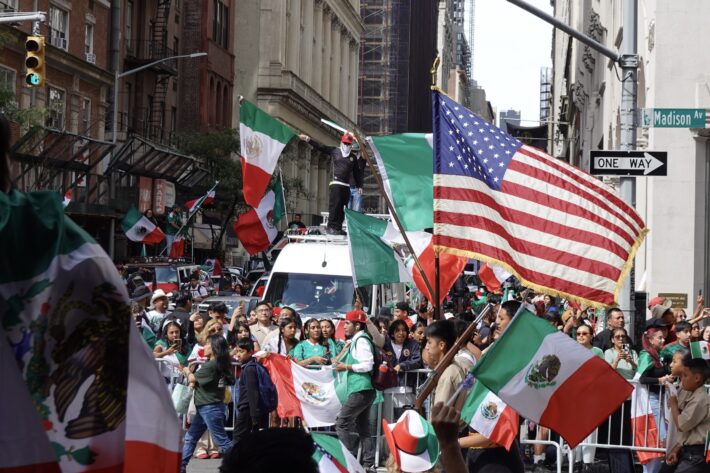
With Immigration Customs and Enforcement officers targeting immigrant communities across the country, this year’s annual Mexican Independence Day Parade had a new layer of meaning.
While celebrations were postponed or canceled elsewhere as a precaution, New York City’s Mexican immigrant community decided to proceed with the festivities on September 21 to send a message of strength and pride. Along Madison Avenue, a show of dancers, festive floats, mariachi bands and lowrider cars made their way up the parade route, while surrounding streets were filled with vendors selling tacos, Mexican corn on the cob, and churros.
Mexican Independence Day is recognized annually on September 16th, marking the date when Mexico officially began its war of liberation from Spain. The celebration commemorates what is known as the “Grito de Dolores,” or in English, the Cry for Dolores, when Miguel Hidalgo y Costilla, the parish priest of Domingo, Mexico, rang a bell on Sept. 16, 1810, to announce the battle cry.
“Usually we come together as a community and celebrate where we are from,” said Joselin Deluna, founder of Ballet de Tonantzin based in Queens. “This time it’s more about defending and being prideful of where we are from and showing that we are not going to be made afraid.”
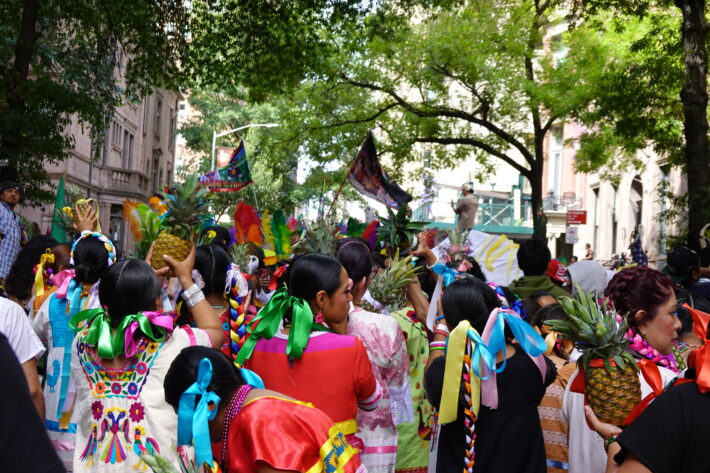
Ballet de Tonantzin, a free, Mexican folkloric dance group, performed a traditional dance from Oaxaca called the Flor de Piña at the parade. Over 30 members danced with pineapples in their hands while wearing traditional, colorful dresses and long braids intertwined with ribbon.
Ingrid Santos, one of the thousands of parade attendees dressed in colors of the Mexican flag, watched the event from the sidewalk alongside her mother. Santos expressed how much the parade meant to her as a first-generation Mexican immigrant.
“When we came here to America, we had so many opportunities that we didn’t even know were possible,” said Santos. “In Mexico we were poor, we were questioning whether we were going to eat. Now here in America we don’t have to worry about that anymore.”
But this year’s celebration of Mexican heritage came with added considerations, given the Trump administration’s immigration crackdown.
According to the Deportation Data Project, a collection of immigration enforcement data acquired by lawyers and academics who filed Freedom of Information requests, ICE has deported more than triple the amount of New York-based immigrants this year, as of August, compared to all of last year, as reported by The Gothamist.
And the Trump administration isn’t letting up.
On the Department of Homeland Security website, Assistant Secretary Tricia McLaughlin accused New York City Mayor Eric Adams of protecting “barbaric criminals with prior convictions for rape, murder, [and] drug trafficking” by ignoring ICE detainers.
But the Deportation Data Project shows that only about 28% of arrested immigrants in New York City had criminal convictions.
“People have cause for concern because what we are seeing happening around the country is real and with the quotas, there’s a lot of pressure on ICE to make as many arrests as possible per day,” said immigration lawyer Rachel Einbund, adding that a parade could put some people at risk. “So something like this, where you have a large gathering of immigrants, certainly creates the perfect breeding grounds for fear.”
In other U.S. cities, Immigration and Customs Enforcement has disrupted cultural celebrations.
Mexican Independence Day celebrations in Chicago were postponed last month, after Stephen Miller, White House deputy chief of staff and homeland security advisor, suddenly arrived in the city. Illinois Governor JB Pritzker gave a press conference warning Chicagoans that Miller’s presence was connected to the festivities. The next day, on Sept. 3, El Grito Chicago, a two-day festival commemorating Mexican Independence was canceled. An announcement on its website said they would be postponing the event for the safety of their community.
“We were a little bit worried once we saw that Chicago’s [event] got cancelled,” said Vanessa Mayorga, the mother of one of the Ballet de Tonantzin dancers. “I think now everyone wants to showcase that we are still here, we are still standing strong even though left and right we are getting punches.”
Parade watchers Leah Calixto and her mother Rosie Herrera felt an added obligation to attend this year’s parade after hearing about Chicago’s cancellation.
“I have a cold right now and I still wanted to come,” said Calixto. “I need to be here to show that we are not afraid we are not going to let ICE and the Trump administration try to make us feel little.”
The event proceeded successfully with no reported appearances from ICE.
“I do feel like a lot of people are still a little afraid,” said Deluna, adding that some of Ballet de Tonantzin’s summer events were canceled out of fear. But she was determined to participate in New York’s parade. “We are not scared,” she said. “I don’t know how to say it in English… but in Spanish the saying would be somos muchos. ‘They can’t do anything to us together united.’”