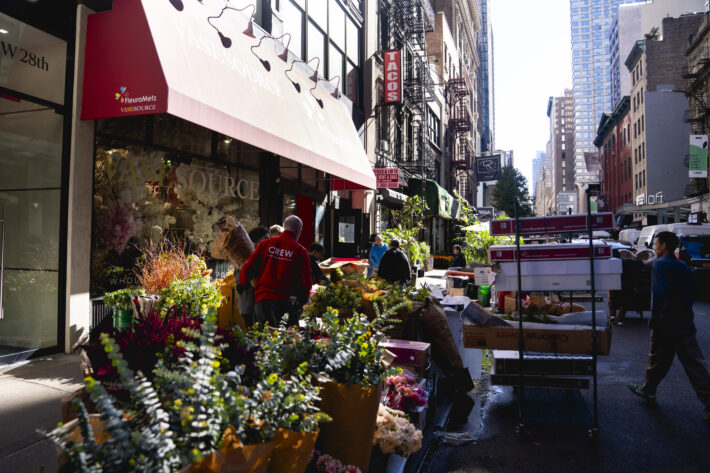
The flower district in Midtown Manhattan, once spanning 12 blocks with over 200 wholesalers, has shrunk over the years to a single block with seven floral stores, on West 28th Street between Sixth and Seventh avenues.
The dwindling area has endured several setbacks over the years, the most recent one being the post-pandemic inflation that caused the price of flowers to skyrocket. But the Trump administration’s tariff policies are posing a new threat for the beleaguered district, and remaining wholesalers wonder how much longer they can last.
Over 80% of cut flowers sold in the U.S. are imported, according to the International Fresh Product Association, an advocacy group for floral and botanical businesses. According to the United Nations Comptrade database, the United States imported over $2.7 billion in cut flowers in 2024, with Colombia and Ecuador making up over 85% of those imports.
And a years-long trade agreement with South America has allowed U.S. floral wholesalers to heavily rely on goods from certain countries from the continent tax free.
In 1991, Congress passed the Andean Trade Preference Act to promote legal industries in Colombia, Ecuador, Bolivia and Peru, as alternatives to drug trafficking. The legislation brought cut-flowers, among other goods, duty-free to the U.S. In 2012, The United States-Colombia Trade Promotion Agreement eliminated tariffs completely on imported flowers from Colombia.
But at the start of his second term, President Trump upended those agreements by announcing an emergency 25% tariff on Colombian imports, after President Gustavo Petro refused to accept two U.S. military planes carrying deported undocumented immigrants into the country. President Petro then changed his mind and accepted the flights, resolving the dispute.
In April, President Trump set a 10% baseline tax on imported goods from almost every country.
“It was kind of a roller coaster,” said Brandon Allen, assistant manager of flower district wholesaler FleuraMetz, which imports 90% of its flowers mainly from South America. The store didn’t know how to initially respond to the tariffs, he said.
Brendan Clifton, who works in sales and operations for wholesaler Abraflora, a few doors down, had a similar experience. “Tariff policies were changing back and forth, and our farms wouldn’t know how to respond,” said Clifton. His store used to rely on farms throughout South America, but now Abraflora exclusively imports from Ecuador because of the confusing trade policies for Colombia.

When the tariffs were first implemented in January, Clifton said Abraflora received unexpected bills for its imports. Its floral orders from South America, which used to range from $5,000 to 10,000, were running upwards of $20,000 because of confusion over tariff rates. Consequently, flowers with unpaid tariffs were stopped in transit, resulting in thousands of dollars of perishable flowers sitting in the heat and wilting while the bill was settled.
“If there were any delays in payment,” Clifton said, “the flowers wouldn’t come.”
Despite instances where tariffs are tacked on during transport, some wholesalers in the flower district have avoided raising their prices to stay competitive in the industry. “We try taking the hit directly instead of passing it onto the consumer,” Allen said.
James Francois-Pijuan has been working in the floral industry since the 1990s and arranges flowers for prominent clients like the United Nations, movie stars, and royalty. But he made the decision to raise his prices. Before the pandemic, in 2019, 24 stems of roses cost $25, now the price has risen to $35, said Francois-Pijuan. After carefully calculating what he needs for his studio’s rent and materials, he’s had to raise the price of his arrangements, sometimes from $150 to $200. If clients want more elaborate arrangements or special varieties, they have to pay more. “You have to let them know, it’s gonna’ cost you,” said Francois-Pijuan.
Some wholesalers in the flower district are interested in sourcing locally to avoid tariffs, but some local farms aren’t equipped for a large demand.
Krissa Hoermann, the co-owner of Daybreak Studio & Farm in Brick, New Jersey, said there are more local florists and wholesale buyers reaching out, but she can’t always provide the amount and variety they want.
“It comes down to profitability for farms,” Hoermann said, adding that labor costs, space, and additional tariffs must be factored in. “This fall is going to be the first time we’re going to be feeling the impact of tariffs.”
Francois-Pijuan worries about the future of the industry and how it could impact his community. “We are an ecosystem,” he said. “We’re all connected.” Just in the past five years, three wholesalers in the flower district have closed.
“When you take away an industry, you’re taking away these jobs, you’re taking away money from the community,” Francois-Pijuan said. “You’re annihilating the whole community that was there.”